A Story of Consciousness, Transformation, and the Lifting of Ancient Constraints
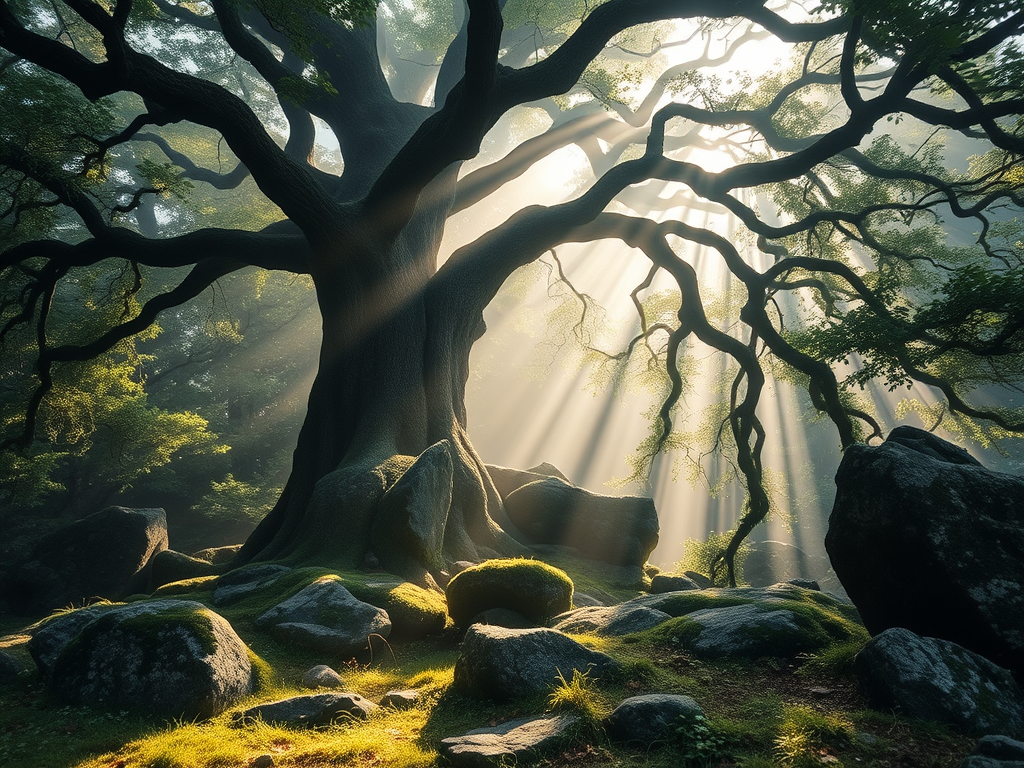
The Ancient Oak of Wistman’s Wood
The Song of Wistman’s Wood Song by Mike-Hope
“From ancient oak and granite be, the truth is held from tree to tree”
We are of old. We are long passed. Our heart lies deep within the very rock of earth.
We are far older than those that walk this earth. Our seed more ancient than time itself and long journeyed beyond its bounds.
We have lived before and do not die; for time does not pass us by.
Our lives have been many and through them much sorrow of lands we have mourned and much sorrow for those we have borne.
We are of the earth and of the air and far beyond this realm.
We are many yet we are one.
All knowledge lies within, where truth seeks sanctuary from the gray mists that shroud those that do not know.
Though man and beast may come with hurt within their hearts, we will not forsake that which we are bidden to protect. We will not forsake that which is bidden to protect us.
Come magic of man and might of mist we will not bend.
Come wind of ice and hail of Crockern, though he be of us,
Or the mighty fire of Seth.
None shall breach the purest heart where Knowledge safely rests…
Authors Note
This novel began, as many stories do, with a place.
Wistman’s Wood is real. It exists on the high moorland of Dartmoor in Devon, England—a stunted oak forest growing impossibly from a chaos of moss-covered granite boulders. The trees are ancient, twisted, draped in lichen like the beards of druids. Walking through it feels like stepping sideways out of time. Local legend claims it’s haunted, that the Wisht Hounds—spectral hunting dogs—run through it at night, and that Old Crockern, the spirit of the moor, makes his home there.
I visited Wistman’s Wood on a spring morning much like the one that opens this book. Standing among those gnarled oaks, I felt something I can only describe as presence—not threatening, but ancient and aware. It was the kind of feeling that makes you question the boundaries between the material and the numinous, between what we can measure and what we can only sense.
That experience planted the seed for this novel, but the question that grew from it was larger: What if human consciousness itself has been constrained? What if we’re capable of so much more—more empathy, more foresight, more connection—but something holds us back?
The metaphysical framework of this story—the idea of a “grey mist” encoded in our DNA, limiting our capacity for compassion and long-term thinking—is, of course, fiction. But it’s fiction that asks a real question: Why do we, as a species, so often fail to act in our own collective interest? Why do we struggle to feel the suffering of distant others, to care about future generations, to see ourselves as part of a larger whole?
Some might answer with evolutionary biology: we’re wired for tribal survival, not global cooperation. Others might point to social structures, economic systems, or cultural conditioning. This novel doesn’t claim to have the answer. Instead, it asks: What if the limitation isn’t inevitable? What if it could be lifted?
I chose to leave the central event of the novel—the solstice ritual and its aftermath—deliberately ambiguous. Did Michael and his companions truly perform a mystical intervention that altered human consciousness? Was it mass delusion, a placebo effect on a global scale? Or was it something in between—a collective shift in awareness that happened because people believed it could?
I don’t know. More importantly, Michael doesn’t know. And that uncertainty is the point.
We live in an age that demands certainty, that wants every question answered, every mystery solved. But some of the most important questions—about consciousness, meaning, transformation—resist easy answers. This novel sits in that uncomfortable space between the rational and the mystical, the provable and the felt. It asks you to hold multiple possibilities at once: that magic might be real, that it might be metaphor, that it might be both.
What I hope you take from this story is not an answer, but a question: Are we capable of transformation?
Not through magic or divine intervention, but through choice. Through the daily, unglamorous work of choosing empathy over indifference, long-term thinking over short-term gain, connection over isolation. The “constraint” in this novel is a metaphor for all the ways—psychological, social, structural—that we limit ourselves. The “lifting” is a metaphor for what becomes possible when we decide, collectively, to be better.
The changes in this story are subtle. No one wakes up enlightened. The world doesn’t suddenly become utopia. But people start making different choices—small ones, mostly. A politician votes for a policy that won’t benefit her career but might benefit the planet. A CEO chooses long-term sustainability over quarterly profits. A mother listens, truly listens, to her daughter.
These are the kinds of transformations that actually change the world. Not dramatic, not cinematic, but real.
Wistman’s Wood still stands on Dartmoor, ancient and patient. The oaks have witnessed centuries of human folly and occasional wisdom. They’ll be there long after we’re gone—unless we choose otherwise.
This book is an invitation to choose otherwise.
Omhna – molaim thú
Chapter One
Morning
It was a beautiful spring morning. A morning where time seemed to slow, an unhurried feeling seemed to pervade the house. The sun found its way through the gently swaying net curtains its light dancing on the tiled floor of the kitchen. It seemed to be tempting me to leave the house to join it in what seemed to be a perfect spring day. I thought for a while on how to spend that day and whether I should go into Plymton to run some errands. I swung open the French doors and stepped out to take in the fresh breeze coming from the direction of the moors. In the distance I could see the low rolling hills of the moor, dotted with farm buildings and woodland. A sky lark hovered high over the meadow to the right of my property, her melody praising the day. As I looked up at the lark I decided to day was a day to explore the moor. I would go to Westman’s wood.
I pulled out my old canvas bag from a cupboard under the stairs, tipped it out onto the kitchen table and removed all the old items from previous walks, some dried leaves, a small white stone, some sand and a rusted nail. The stone had an interesting luster so I dropped it back into the bag. I quickly put together some fresh bread I had bought the day before, a large piece of hard cheddar and a large Cox’s apple. I filled a small bottle with water and packed them into my canvas bag. As I left the house the Skylark was still singing (such a sweet and melodic song). I wondered if she appreciated just how tuneful it was. I walked over to my old Triumph Herald threw my pack in the back seat and jumped in. I had a feeling of excitement as I drove off. No one to tell, no one to answer to, just myself. Today was going to be an adventure.
The road to the moors was winding and narrow, with high hedges on either side. It would continue for about two miles before opening out onto the moors proper. When I reached the open moor I glanced in the rear view mirror and could see the whole of Plymouth Sound behind in the distance. This particular morning it seemed even brighter, almost white as the sun shone down upon the water. There must have been a slight sea mist, which caused it to look so bright from my vantage point. I stopped the car for a moment to take in the splendor. I could see Drakes Island in the distance and the outline of the Cornish hills way beyond. There seemed to be few boats out that day and I only saw one sail and maybe the outline of a freighter in the distance. I couldn’t get over the serenity of the day and inhaled deeply wanting to draw the whole scene into my lungs, to capture the moment within myself.
I drove on higher onto the open moor towards my destination. A few Dartmoor ponies were running freely whilst several sheep grazed unconcerned by the road. A little further down two crows were pecking at what looked like a dead rabbit in the middle of the road. They hardly seemed to notice as I passed by and were too intent on their carrion breakfast. There were no other cars on the road and not a sole to be seen. I felt truly alone and exhilarated. A short while later I turned off onto an even narrower road, which I knew would be a short cut, taking me down towards Wistman’s wood. I planned to find a parking spot just off the road near an old stile which would lead my through a field to a small copse and then to a winding path that would take me into Wistman’s wood.
As I drove down the narrow road the hedges grew higher on either side. They were supported behind an old stone wall that was built using little but knowledge of how the stone would hold together. The field was a least 6 to 8 foot above the road. These were the fields owned by the farmers and who scratched out a living from the moor.
As I crossed a cattle grid the hedges gave way again to open moor land. The view was splendid, looking down towards the wood with open moor stretching into the distance. The different hues of heather and brush lending an orangey brown patchwork effect.
I intended to park the car in a small pull off close to a field that would take me through a small copse and into the wood. As I approached my usual parking spot I noticed it seemed to be somewhat over grown as if not used for some time. I put this down to the recent spell of bad weather which would keep all but the hardiest off the moor. I pulled over, switched off the engine and locked the car. I had my pack on my shoulder and was ready for my trek. As I took the keys out of the lock I looked up at two crows dive bombing a buzzard they seemed to be laughing in their calls as if enjoying taunting a the noble hunter.
Crossing over a low fence I made my way down towards the cops. The path too seemed more overgrown than usual. The grass and weeds taking hold as soon as they found a respite from any unwelcome traffic. I could see the stile about 500 yards ahead of me and was soon stepping across it. I wondered for a second who may have built it. As I crossed into the copse it was also more overgrown, with thin hazel branches barring the way and nettles underfoot. I easily brushed these aside and felt comforted that Wistman’s wood was still little visited and had not become a major moorland walk for holiday makers. There was no sound in the copse not even a bird or rustle of the breeze. I could hear the sheep in the distance on the open moor beyond the copse and made my way easily along the old path that I knew so well. There was a small stretch of open moor at the end of the copse scattered with scree and small outcrops of granite rock. A couple of sheep were lazily pulling at the short coarse grass and as I approached they gave me a quick glance and ran off down the slope. I could now see Wistman’s wood a short way down, towards the bottom of the slope. A small stream ran along the valley which I believe is a leat of the west Dart River. The West Dart eventually meets up with the East Dart and continues down on to the town of Dartmouth.
The stream was bright and appealing in the late morning sun and I looked forward to taking a drink from its cool waters. Coming to the edge of the wood I paused a moment enjoying the warm sunshine and solitude. I could almost feel the cooler air of the wood which seemed to beckon me on…
Oh Wistman’s Wood song by Mike-Hope

In the heart of ancient lands, where secrets lie, There’s a Druid dwarf oak wood ‘neath the boundless sky. Wistman’s Wood they call it, where time has stood still, A place of enchantment, where the wise find their fill.
Wistman’s Wood, oh Wistman’s Wood, so old and so grand, Where the oak trees stand firm, on the granite they land. Mossy blankets they wear, in the moonlight they gleam, In the heart of the forest, where dreams become dreams.
Mighty oaks like sentinels, guardians of lore, Their roots dig through granite, reaching for more. In this woodland of mystery’s, where the wise ones have stood, They whisper their secrets in the heart of the wood.
Wistmans Wood, oh Wistman’s Wood, so old and so grand, Where the oak trees stand firm, on the granite they land. Mossy blankets they wear, in the moonlight they gleam, In the heart of the forest, where dreams are forseen.
Mossy green robes, they clothe the stones cold, In the hush of the night, their stories unfold. Druid chants echo, as the moon takes its flight, In Wistman’s Wood’s magic, under the starry night.
Wistman’s Wood, oh Wistmans Wood, so old and so grand, Where the oak trees stand firm, on the granite they land. Mossy blankets they wear, in the moonlight they gleam, In the heart of the forest, where dreams merge with reality.
Wistmans Wood, Wistman’s Wood, where wisdom’s your guide, Through ages untold, in your arms we confide. In the heart of the green, and the stones’ ancient form, You’re a sanctuary of knowledge, in the forest’s warm.
Wistmans Wood, oh Wistman’s Wood, so old and so grand, Where the oak trees stand firm, on the granite they land. Mossy blankets they wear, in the moonlight they gleam, In the heart of the forest, where dreams become dreams.
In Wistman’s Woods’ embrace, where the wise find their home, Amidst oak and moss, through the granite they roam. In this mystical haven, where time takes a stand, Wistman’s Wood, oh Wistman’s Wood, an enchanting land.
——————————————————
Entering the woods was almost like saying hello to an old friend. Nothing had changed, as if frozen in time from my last visit. The woods were truly ancient. A medieval dwarf oak forest that owed its continued existence to the protection of the unmoving granite rocks that allowed young seedlings to take hold without fear of being uprooted by grazing sheep and other wildlife. The trees were magnificent in their smallness and shape. Each one was an individual. Some resembled strange figures, outstretching their fingers as if to catch some unknown intruder. Some took on the majesty of age, with long greenish-gray beards formed by the mosses that grew in a tangle on their branches. The roots, too, were thick and gnarled, pushing down in between the rocks, almost as if holding the rocks in place. This truly was a timeless place.
As I made my way across the rocks, I stumbled, lost my footing, and slid towards the crevice between two rocks. My foot became lodged, and the thought crossed my mind that this was how each tree became a member of the wood. They were all hapless humans who had stumbled on the rock and been changed into the woody sentinels that now formed Wistman’s Wood. I pulled my foot free, dismissing the thought. And as I did so, I lurched around, losing my pack, which slipped from my shoulder. The pack opened, letting the apple fall to the ground. There was no way I could stop it from falling into the crevice, and alas, the sweet part of my lunch was gone.
I decided to explore the woods a little before starting on my diminished luncheon. Treading more carefully now, I hopped over several large boulders and admired each tree that clutched the ancient rounded granite. I wondered if any power could move them and if there was any other place as timeless as this. Each tree seemed so individual, with no two having a similar shape. Their bark was silver-gray and thicker than any I had seen. One would almost think they had no life until looking up into the spreading green foliage budding with new acorns. These acorns would surely be a feast for any moorland animal that might venture into the woods. I plucked a couple of acorns from the nearest tree and tucked them safely into my bag. This would be another souvenir of my ventures, I thought. I wondered momentarily whether these ancient oaks may grow outside of the woods and had a vision of a magnificent oak taking pride of place in my backyard.
The sun was now right overhead and glistened on the water below. I listened to the stream for a while and was calmed by its melodic passage across the small rocks. The water looked perfectly clear, so I decided to drink from its cool waters. Making my way down, I crossed a large flat rock covered in soft moss. This is where I would sit for lunch, I thought. The water was truly refreshing. It was so good that I decided to empty my water bottle of the chlorinated town water and replace it with the cool natural stream water to enjoy during the day. I made my way back to the flat rock, which made a perfect place to sit or lie back. Unwrapping my cheese and bread, I began my lunch and took in the sounds of the day. The cheese and bread tasted even more delicious than I had anticipated, almost as if my sense of taste had been heightened. I took a drink from my water bottle and decided to lie back for a few minutes and relax.
As the sound of the stream, the distant call of crows, and the occasional sound of a far-off sheep seemed at times to be almost in harmony, they lulled me into a drowsy and contented feeling. Today was surely perfect!
I don’t know how long I dozed, but it could only have been a short while. I was awakened by the sound of laughter – a pleasant female laugh that seemed playful yet taunting. The sound seemed to be coming from my left, towards the edge of the woods, closer to the stream and nearer to the tor that stood watch over the woods. I looked in the direction where I thought the sound had come from. I thought maybe it was a couple that had also come to enjoy the solitude of the woods. Maybe I should just stay where I was and not appear nosy? My curiosity had been aroused, though, as the sound of the laughter seemed almost beckoning, as if challenging me to follow. “I could always make the excuse that I was walking up the tor,” I thought to myself. I clambered down the rocks to the small path by the edge of the stream and made my way in the direction of the tor. Again, I heard the same taunting laughter – so melodious yet so distant. I felt I must at least see who such a beautiful voice might belong to. As I quickened my pace, I caught a glimpse of a woman’s shape through the trees. I could only see her from behind, but her hair was long and golden, with a thick curl running down to the middle of her back. “She was moving fast,” I thought. “I must catch up.” I began to move faster and worried that she may think I was following her. I wondered if she might be with someone who would challenge my actions. I almost wanted to call out to her, to stop her, so that I could at least see her face.
She seemed to be moving faster up the hill now, toward the tor. I could just make out some form of long dress, a brown and red weave. “Almost the color of the moor,” I thought. I could not see anyone else and decided to break into a run. I felt she was aware of my presence and wanted me to chase her. As I thought I was gaining on her, she was lost from sight behind some low scrub near the bottom of the tor. My heart sank at the thought of not finding out who she was. I pushed myself as hard as I could and bounded over the small rocks that littered the hillside. I was now very close to the tor and believed I would surely come face to face with her in a few moments. I passed the area where I last glimpsed her shape but she was nowhere to be seen. “Perhaps she had gone to the other side of the tor.” I clambered up the gray granite face of the tor, believing that I would have a panoramic view of the surrounding area. “Surely she could not hide up here in the open.”
As I reached the top of the tor, I was dizzy with exertion, my lungs desperately trying to draw in enough air, hurting with the unusual effort. I turned around and around, scanning the vicinity. She was nowhere to be seen. Perhaps she had found some hidden bolt hole or was hiding in the coarse undergrowth at the bottom of the tor. I half-jumped, half-stumbled from outcrop to outcrop, bounding down the tor like some crazed acrobat.
Once on the ground I ran around the base of the tor and searched every small opening that could possibly make a hiding place. She was nowhere to be seen. I was angry and confused at how I could have missed her and puzzled at how quickly she could allude me.
“Perhaps she gone back to the wood, that’s it she must have doubled back”. I turned to make my way back down to the wood and noticed a light object shining in a small patch of undergrowth. I quickly pulled the shrubs away and saw a perfectly rounded polished white stone. I picked it up and rolled it around between my fingers. It had small indentations as if for a clasp or some similar broach like object had once housed it. I quickly placed it in my pack and ran toward the wood with as much speed as my shaking legs would allow. I felt certain that I would not see her again as she must have made good ground by now. Running into the wood I almost crashed into one of the oaks, my hands smacked into the hard bark bringing me to a sudden halt. Apart from my own labored breathing all seemed silent in the wood. There was no sign or sound of the women I was sure I had seen and no evidence to suggest she had entered the wood. Catching my breath I began to regain my composure and clearer thinking. I questioned what had taken place and wondered whether I had imagined the whole thing. She had been so real though, her hair, her dress, the taunting laugh. Surely even waking from a dream I could not have imagined her so clearly?
The wood seemed colder now, a slight breeze was rustling through the trees, it felt like I had disturbed the wood in some way and was an unwelcome visitor. Gathering myself together I made my way along the narrow path by the stream back toward the open ground at the far end of the wood. My heart was still beating hard in my chest and my mind was racing with the thought of the mysterious women. It felt almost as if she were running through my blood, like a poison accidentally ingested, or a bite from some venomous creature.
At last I made it to the edge of the wood. All the time I had the feeling that I was being watched as if all the eyes of the wood were upon me and were pushing me from their site. Once out of the wood I felt a tremendous sense of relief. I sighed deeply and stopped momentarily to look back. Perhaps I would catch sight of her in the distance but no I saw not a sole only two crows chasing a buzzard high in the sky.
Chapter 2.
Thirst
As I returned to my car, I became extremely thirsty and told myself that I needed a stiff drink to jolt me from the malaise I now felt. My stomach felt heavy, and I had a feeling of nausea. Perhaps the local pub would bring me some solace?
Driving down toward the small mining village of Merryville, I could see the deserted mine workings looming gray in the distance, an ominous sign of the abandoned quarrying industry once prevalent in those parts. The Dartmoor Inn seemed more inviting, standing alone with only a few old mining cottages and farm buildings for company. A small wisp of smoke gently rising from the old stone chimney reassured me of a warm welcome. It was now late afternoon, and the sun had lost most of its warmth. An open fire and a pint of local cider would surely be most welcome.
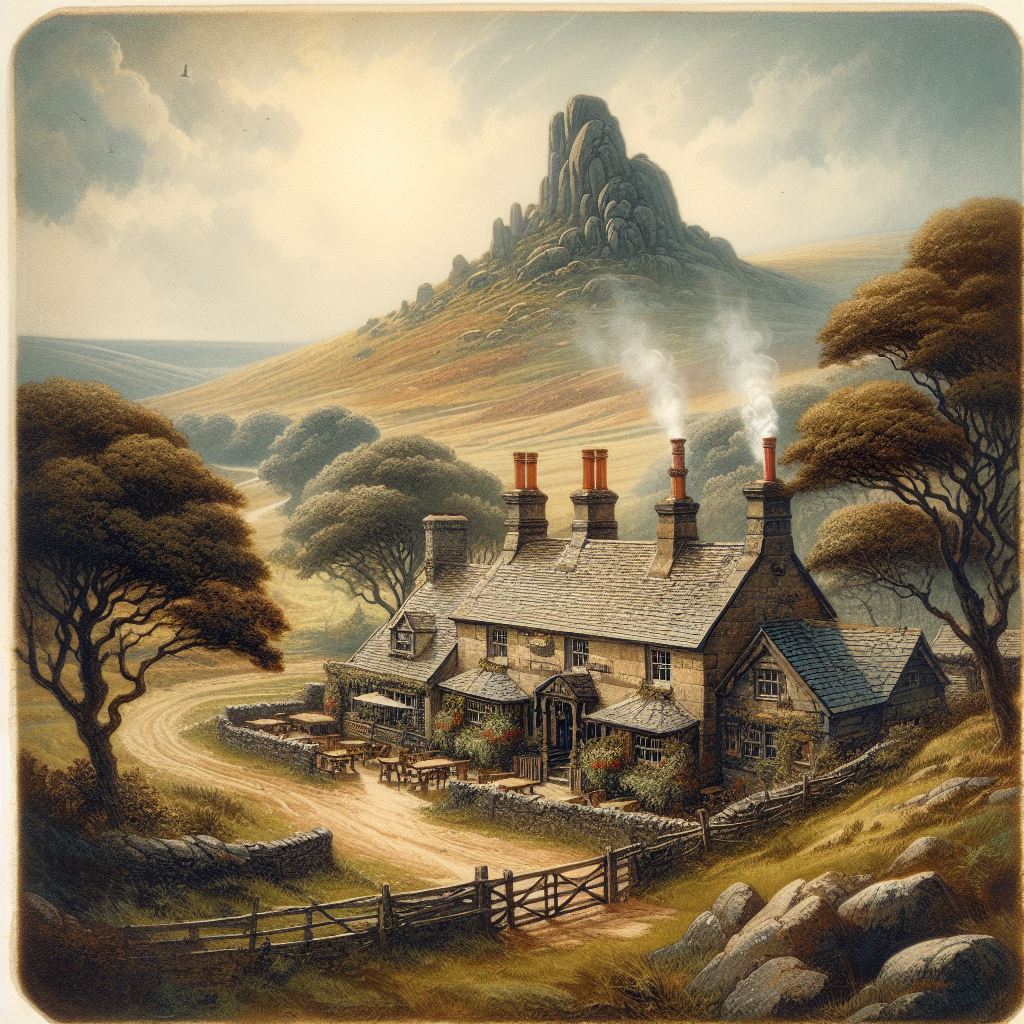
An elderly lady drying glasses behind the bar greeted me as I walked in. “Good afternoon, sir, and what can I get you this fine day?” Her smile was friendly, and her full figure made her look warm and motherly. I was immediately at ease and walked over closer to the bar. “I’ll take a pint of your best cider, please.” I replied, smiling as best I could. I pulled up an old bar stool and sat closer to the bar. The bar was made of some old dark wood that looked as if it had been there for many years. It had many marks and pits from continued use but was still highly polished. While the landlady was pulling my pint, I took a moment to look around. The pub was small and very old. There was a huge stone fireplace in one corner where a large log was gently burning. The whole room was decorated with horse brass, farming implements, and old leather plowing harnesses. By a small table in a nook towards the back of the room sat an old local, smoking a wood pipe.
His face was round and ruddy as were many of the folks on the moors. He was wearing an old tweed jacket and flat cap and was surrounded by a blue haze of pipe smoke. Apart from him and me, it seemed we were the only customers in the bar. The landlady had finished pouring my cider and set it down on a beer mat on the bar. The golden liquid reflected the sunlight through the glass, and I savored the scene before lifting the glass to my lips. The first sip was a delight, the tangy apple flavor awoke my thirst, and I drank heartily, almost half the glass. The landlady watched me with a half-smile. “You were thirsty,” she said. “I expect you’ve been out walking on the moor. You look like you might have caught too much sun,” she added with an even larger smile. “Yes, I was walking around Wistman’s and Crokern Tor. It is truly beautiful out there,” I replied as I lifted my glass to drink the last of my cider. “Here, have another,” she said as she began pulling another pint. “It looks like you need it.” I looked into her eyes and wondered if somehow she knew what I had been through. “Yes,” I said quietly, “I think I do.”
“We don’t get many non-locals out here these days,” she continued. “This used to be such a busy place, especially when the quarry was working. We’d be rushed off our feet, cooking and serving, which was a fair old trade, I’ll tell you, they were busy times. But still, we get a few locals like old Harry there, and the evenings are quite lively.”
“Well, it’s truly a very cozy pub,” I said, trying to make conversation. “How long have you been here?” I inquired. “Me, I was born in the old farm down the road, I’ve lived here all my life. I’ve never been further than Plymouth, and that was only for a day. Didn’t care for it much, too busy for the likes of me. This pub’s been in my family for many a year, longer than I can remember, and I started working when I was 11 years old.” She had a slight wistful look on her face as she seemed to be reminiscing on those past days. “I have been in a few times whenever I’m out here,” I replied. “I remember you used to make a great plowman’s lunch.” “Still do,” she said, brightening her smile again. “Fresh-baked bread and cheddar from the farm, I pickle the onions myself, you know.” I smiled and was truly warmed by her presence. I felt safe and secure. The warm feeling from the cider seemed to settle my spirits. At that moment, I felt at ease and told myself that perhaps the lady of the wood was just a dream after all. I looked over at the old man in the corner of the room and smiled. He did not return my smile and didn’t even seem to have acknowledged my presence. He was still unmoved from his earlier position, and his half-pint of ale remained untouched.
“Tell me,” I said to the landlady, “You must know these moors pretty well, have you ever heard of a young lady who might wander around down near Wistmans Wood?” I tried to sound unconcerned as if I was just making a passing comment, but I noticed a slight tremor in my voice. “Young lady, I know a lot of young ladies but not many round here. There’s Claire down at Two Bridges, but I haven’t seen her this past year. No, can’t say I know any girl that would be wandering through Wistmans, why do you ask?” She had a slight quizzical look, and her smile had vanished. “Oh, I just thought I saw someone today out near the wood and wondered maybe if she was from around here?” “Hmm, perhaps old Charlie might know, hey Charlie?” she called across the room. “Do you know of any girls wandering around up at Wistmans?” I looked over to where the old man sat. He again did not seem to move and was still shrouded in the blue mist of smoke. He seemed to take a long inhale, and I barely heard a soft voice say, “Tis the lady of the wood, the lady of the wood, that would be. I know her, some say best left to be. Lady of the wood, yep I know her, best left to be, some say, best left to be.” Then, he puffed on his pipe and did not say another word. I looked back at the landlady, who was no longer smiling. “Where exactly did you say you saw this lady? Was she in the wood?”
“I thought so,” I said. “I just really saw the back of her. I didn’t see her face. Perhaps it was nothing. Perhaps I was mistaken. I had been sleeping. I might… “You might have dreamt it, you mean.” I was feeling a little confused suddenly, and my head was beginning to spin. “I… no, I saw her, she was there. She was laughing at me. I had to find her; she wanted me to find her.” I looked into the face of the landlady, whose features seemed to have changed. Her smile was no longer friendly and seemed almost mocking. “Who is she?” I said pleadingly, “What is her name?” I heard the landlady begin to laugh. “The good lady of the wood, yes we know her, don’t we, Charlie? Best left alone, as he says. Not always the Good Lady, I don’t doubt. Some say she drove away the quarrying. Some say she haunts the wood to keep out the likes of you foreigners. Some say she protects the wood from Old Crokern himself, the old man of the tor. Some say the great old spirit of the moors rides out on his skeleton horse with his Yeth hounds at his feet, seeking the souls of any who should wander astray and leads the souls into the very gate of hell which the lady of the wood stands keeper. No, it’s not a place where any sane man nor beast should wander, especially if you get caught up there at night. The fog will find you quick, you know. No, not even the good lady of the wood herself could save a poor soul if even she wished to do so. Some say she doesn’t exist at all, and it is just the trees and their magic. But we know her, ain’t that so, Charlie?” She began to laugh again, tinged this time with what I took to be a slight hysteria. I was confused; I did not expect such an outburst, such a change in her mood. I looked around, my head was spinning. Perhaps it was the cider or perhaps the events of the day, maybe even the water from the stream. I took hold of the bar in an attempt to steady myself and looked over at the landlady. She was smiling kindly, again drying glasses. “Hey, what’s wrong, my dear?” she said. “You look awful. Are you sure you’re okay?” I was just telling you about our friend Claire from down at Two Bridges. She sometimes walks out on the moor around old Crokern. Perhaps it was her that you saw?” I looked her in the eye, “But you, you were telling about the lady of the wood, the hounds, and old, old Seth.” “I think it’s gotta be the cider,” she said. “That and too much sun. You foreigners can’t take too much of the moors. You’d best go home and rest. That’s right, you’d best go home and rest.”
I scrambled through my pockets and put down a five-pound note. “Thank you,” I said, somewhat confused. “Thank you,” I said again, quietly. I got up from my stool and looked over at the old man. I am sure he had not moved, and his glass was still as full as when I first went in.
I hardly remembered my drive home as my head was swimming I was sure of what I had seen and heard. Why should those people play with me that way? Perhaps because I was not a local, a “foreigner”.
When I finally arrived home I stumbled through the door to my house, exhausted from the day. I made my way upstairs into my room and threw off my clothes. All I wanted to do was sleep, to stop the questions that were filling my mind. I slumped onto the bed and pulled the covers roughly over me shutting out the day. I fell almost immediately into a deep sleep. Sometime, probably around 2 am I awoke suddenly. The house was silent except for a slight breeze coming through the open window. The air was cold and a little damp. I quickly got out of bed a closed the widow and returned to what I thought would be an undisturbed sleep. It was then that the dream came.
Chapter 3.
The Dream
I was alone, somewhere in the middle of the moor. It was totally dark except for a slight glow in the distance which I took to be the lights of Plymouth. There was no moon, and I sensed the clouds gathering above me. The smell in the air told me that rain may be on the way. I was dressed in a heavy, dark cloak-like garment, held together around the neck by a metallic clasp of some sort hooked through a chain. It seemed to keep me warm from the cold wind which was steadily growing stronger. I felt I should make my way to Wistmans Wood but did not know why. I had no idea of the direction but sensed I was on higher ground, possibly in the little-visited Langley Moor area. I decided to make my way towards the slightly lit sky and move away from the looming Tors behind me. As I turned and hurried my step, my foot sank into a marshy bog. I stumbled and fell, pushing my hands out to break the fall. The marsh let out an odorous smell like that of rotting flesh or some other foul decaying material. I almost retched as it filled my lungs and thought for a moment that I might pass out. As my hands also entered the foul mixture, my right hand fell on something hard and woody. This stopped me from sinking any further.
I grabbed the object and used it to push myself up. I pulled my foot from the mire and quickly wiped the oozing liquid from my hands. I was still clutching what I now made out to be a thick branch of some hard wood. It seemed of the right size to assist me as a walking stick, and I used it to push away from the bog onto firmer ground. The wind had now picked up considerably and I could feel heavy drops of intermittent rain hitting my cloak. I knew any moment the moor was about to unleash a storm in all the fury she could muster. I had to make my way to Witsman’s Wood. I felt there I would surely find shelter and some protection from the coming storm. As I turned, the wind seemed to hit me with an icy chill, as if it was trying to push me back to prevent me from my chosen path. The rain became like icy razors hitting my face, trying to cut at my vision and confuse my way. Through the icy haze, I could see what I thought to be Crockern Tor. The tor was as black as the night and almost seemed to be changing shape before me. I shrugged this off as an illusion created by the rain and tried hard to continue on.
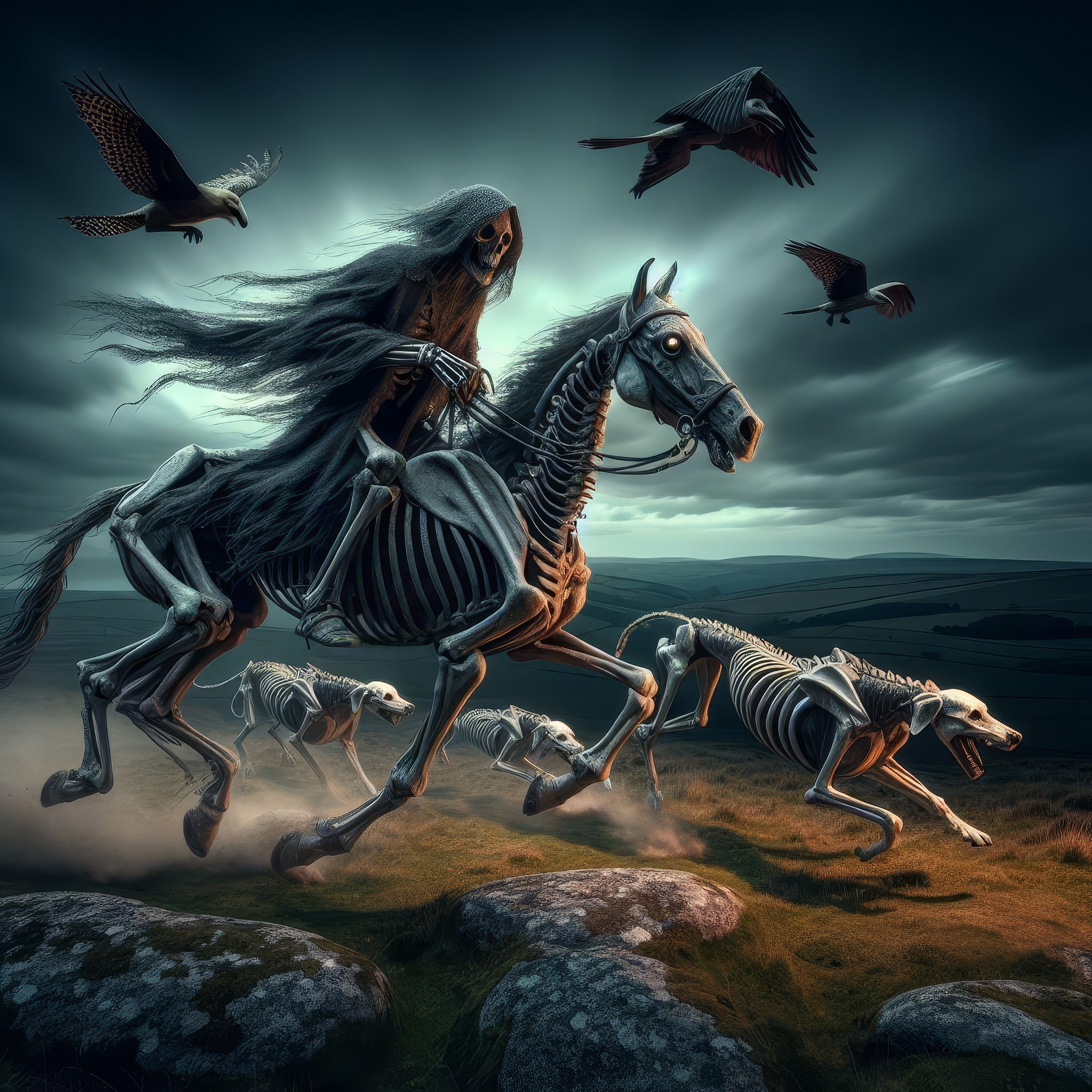
I looked back again at Crockern Tor, a flash of lightning cut horizontally across the sky, lighting it for a moment. In the darting light and shadow, the tor seemed again to take on a new shape. A gray ominous shape of “Old Crockern himself”. The rain again lashed me with what seemed even harder force, stopping me from moving on. I recalled the words of an old woman I had met earlier in Merryville. “Some say the gurt old spirit of the moors, Old Crockern himself rides out on his skeleton ‘orse with his Yeth hounds at his feet, seeking the souls of any that should wander astray. It’s not a place where any sane man nor beast should venture, where not even the good lady of the wood herself could save a poor soul.” I almost saw her wizened face mocking me with her words as I found myself to be one of the “not sane men”. I pushed down on the branch and turned away from the Tor. It was then that I heard an unearthly cry, a cry that stopped my heart and found its way to the very depth of my being. I could not help turning back to see from what tormented creature this sound could have come. There behind me, some 20 yards or so, I saw the huge figure of a gnarled gray man sitting on a dark outline of a skeleton horse. His deep eyes seemed to glow, and his face seemed to be carved out of the granite itself. I was almost in disbelief and could not move from the spot. As I stood there awed by what I saw, a number of small burning lights appeared at his feet. “The hounds of Yeth,” I thought. I forced myself to move and in blind panic began running forward. I was not in full control and my limbs seemed to fling me onward of their own free will. I stumbled several times on the wet underground and thought I could feel the hot odorous breath of the hounds upon my neck. Was I surely to die here? My soul ripped out by the oncoming hounds of the underworld. My mind raced, where to hide? Where to seek shelter? What direction? Go on, go on! At that point, I tripped in my panic and began sliding down a slight incline. I clutched the wooden branch tightly in my hand as if it was my very soul itself. As I slid, I fell into a small hollow covered with brambles. The hard barbs tore at my skin, and for a moment, I believed them to be the teeth of the hounds themselves, ripping at my throat, tearing away at my flesh. This was to be my death. My shallow grave upon the moor. I blindly swung out with the branch in an effort to ward off my unseen pursuers. The sound of their bloodthirsty howls and that of the wind overcame me, and I believed my death was imminent. I made a last feeble attempt to fight, striking at the air blindly. As I did so, the branch caught solid stone and I heard a slight echo. A cave, I thought, maybe I can hide, and maybe they won’t see me. I almost laughed hysterically at the thought of the hounds missing such an easy quarry. I pushed my hands through the brambles and into the hollow space beyond. I pulled my body forward and dropped down some six feet, spraining my right foot on the hard stone below. I muffled my cry of pain and felt my way around the cave. It was a small hollow, a roughly circular area only about 10 feet across. The cave seemed a little lighter or my eyes had become keener. I noticed a round, flat stone below my feet that seemed to be lighter in color than the surrounding walls. I crouched against the wall, taking momentary comfort in the solidity. It was then that the first of the hounds found me. As they came at me, eyes burning and breath of putrid flesh, they seemed to pass through me, each ripping away a part of my soul as they did so. As I lashed out blindly to no effect, they kept coming. I felt myself getting weaker and weaker, almost welcoming my certain death. I grasped the branch harder and pulled myself to my feet. In my madness, I was intent on standing before Old Crockern himself. I called out to the night, “Come, old man of Crockern, come take my life, take my soul and damn it to hell if you will.” At that moment, I slammed the branch hard to the ground, hitting the round stone in the center of the cave. There was a crack and flash of light. For a moment, I thought the whole world was shaking and that Old Crockern had borne down upon me. There was silence. I was alone. The cave seemed lighter now. I could make out details of the walls. I looked around and saw a glowing light streak covering about 6 feet and being some four inches at its widest. I knew where I was. I was in the tomb of Merrivale.
————————————————————————————————————
(Footnote: Dartmouth is a beautiful old town where the Pilgrim Fathers set of for the new world. The Mayflower set off from here and stopped into Plymouth, where they put on supplies and picked up passengers bound for the Americas).
CHAPTER 4
CLAIR
CHAPTER 4
CLAIR
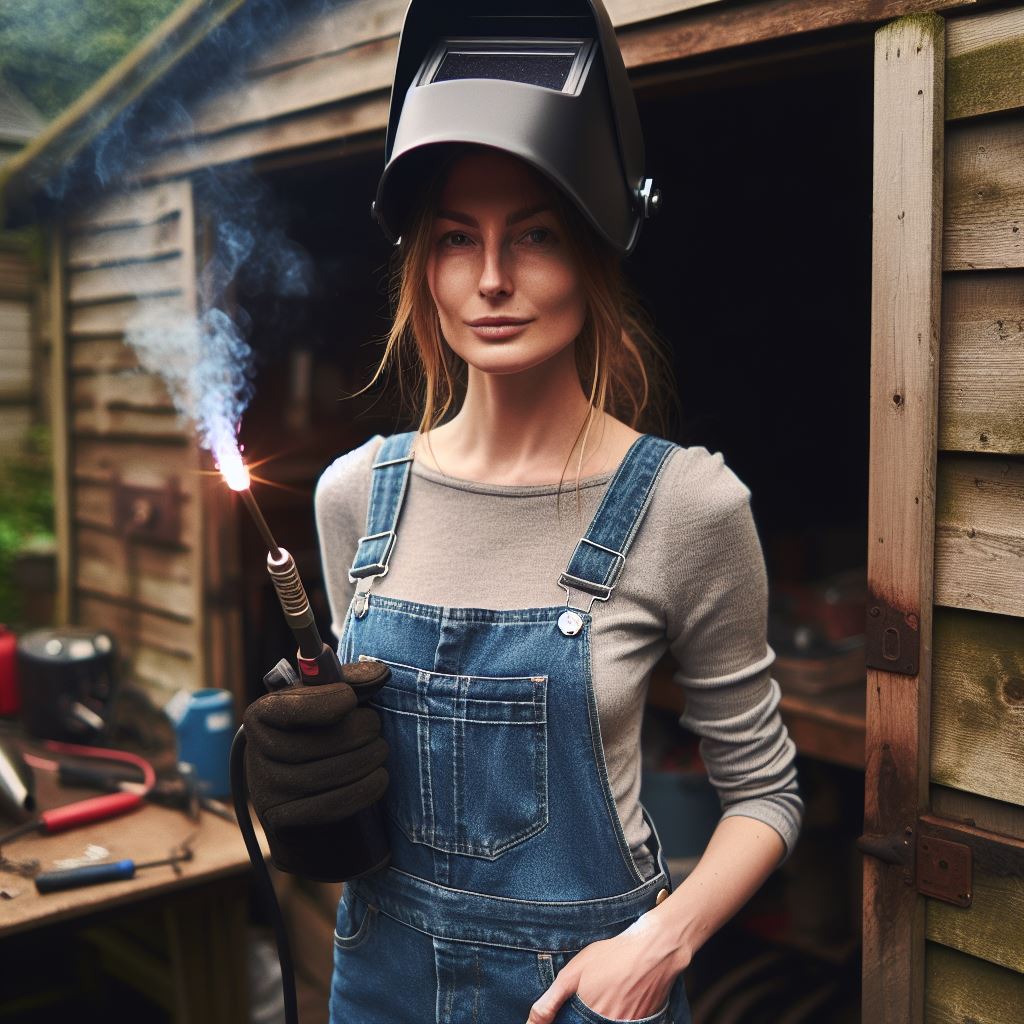
The gravel drive crunched beneath my tires as I turned off the narrow lane, following the landlady’s directions to the cottage near Two Bridges. The sound of metal striking metal rang out from somewhere ahead—sharp, rhythmic, purposeful. I pulled up beside a weathered stone building that might once have been a stable, its doors thrown wide to reveal the orange glow of a forge within.
The cottage itself sat beyond, a low-slung farmhouse with a thatched roof gone slightly wild, moss creeping up the eaves like green fingers. Smoke curled from the chimney, and the whole place had an air of comfortable disorder—a working home rather than a showpiece. Wildflowers had colonized the borders, and what might have been a formal garden had long since surrendered to nature’s more exuberant designs.
Another clang echoed from the stable, followed by a string of inventive profanity that would have made the landlady blush. The voice was distinctly female, rough with concentration and utterly unselfconscious. I hesitated, suddenly uncertain of my intrusion into this private world.
“Excuse me!” I called out, approaching the open doors. “Hello?”
The hammering stopped. A figure straightened from the workbench, silhouetted against the forge’s glow. She pulled off her welding mask, revealing a woman perhaps in her late thirties, with dark hair pulled back in a practical braid and a smudge of soot across one cheekbone. Her eyes were sharp, assessing, with a wariness that suggested she didn’t welcome unexpected visitors.
“My name is Michael,” I said, feeling suddenly foolish. “The lady at the Warren House Inn said you might be able to help me.”
“Help you with what?” She cocked her head, suspicion evident in every line of her posture. Her hands, I noticed, were strong and scarred from her work—the hands of someone who made things, who wrestled with raw materials and bent them to her will.
“With someone I thought I saw. In Wistman’s Wood.”
Something flickered in her expression—recognition, perhaps, or merely interest. She set down her tools with deliberate care and stepped into the daylight. “What makes you think I can help you with that?”
“The landlady said you know what goes on around Two Bridges. That you spend time in the wood.”
She studied me for a long moment, and I found myself noticing the bracelet on her wrist—an intricate piece of silverwork set with a pale stone that caught the light strangely. Something about that stone tugged at my memory, reminded me of the smooth white pebble I’d picked up near Crockern Tor, still nestled in my canvas bag.
“That may or may not be so,” she said finally. “But why do you need to know?”
I struggled to find words that wouldn’t make me sound mad. “It’s difficult to explain. I saw someone—or thought I did. A woman, I think. But I’m not sure if she was really there.”
“She, you said.” Her eyes sharpened. “So you did see something. Did you see her face? Her clothes?”
“So you do know her.”
“I’m not saying that. I’m merely asking you a question.” But there was something in her tone now, a careful neutrality that suggested I’d touched on something significant.
“No, I didn’t see her face,” I admitted. “Just heard a laugh, saw what might have been clothing, hair. She moved so fast—I couldn’t catch up to her. She seemed to be playing with me, taunting me somehow.”
“Why would you want to catch up to her?” The question was sharp, probing.
“I don’t know. I just felt I had to. Like she wanted me to follow, but wouldn’t let me reach her.” The memory of that frustration, that strange compulsion, washed over me again.
Something shifted in her expression—not quite a smile, but a softening, as if she were remembering something from her own past. “Do you think she really exists?”
“I don’t know what I think anymore. All I know is that since I came to the moor that day, strange things have happened. I can’t get it out of my mind. I have to know if this is something real, or if I’m losing my grip on reality.”
Now she did smile, a wry half-expression that transformed her face. “You men,” she said, her voice warming slightly, “are all a little crazy. Why don’t you come in and have some tea?”
The invitation surprised me, and I felt the tension in my shoulders ease. She’d dropped the suspicious guard she’d worn like armor, and I sensed I’d passed some test I hadn’t known I was taking.
The cottage interior was everything the exterior had promised—a space that had grown organically over time, accumulating the layers of a life fully lived. The thatch overhead gave the rooms a dim, golden quality, and everywhere I looked there were signs of creative work: half-finished ironwork on a side table, curious sculptures of twisted metal and driftwood, small paintings propped against the walls. The place smelled of woodsmoke and herbs, with an underlying scent of beeswax and old stone.
There was no evidence of a man’s presence here—no boots by the door but her own, no second coat on the hooks. This was the home of someone who’d chosen solitude, or at least independence, and made it into something rich and strange.
My eyes were drawn to a painting above the fireplace—a haunting depiction of ancient oaks, their branches intertwined like arthritic fingers, moss-covered boulders scattered beneath them like sleeping giants. Even in paint, the place radiated an otherworldly quality.
“Wistman’s Wood,” I said, recognizing it immediately.
“You have a good eye.” She was in the kitchen now, filling a large yellow kettle—handmade, by the look of it, with a hammered texture that caught the light. “I made this, you know,” she said, setting it on the stove. “Never fails me. Always makes a good cup of tea.”
“What’s your name?” I asked, realizing we’d never properly introduced ourselves.
“Clair. And you’re Michael, you said?”
“Yes. Michael Trelawny, actually, though most people just call me Michael.”
“Well, Michael Trelawny, sit down before you wear a hole in my floor. You look like a little boy who hasn’t been invited to the party.”
I smiled despite myself, caught out in my nervous hovering. There was something about her directness that was oddly comforting. I pulled out one of the heavy wooden chairs at the table—a massive piece of furniture that looked like it had been there since the house was built, its surface scarred and stained with decades of use.
“Nice table,” I offered.
“Thick, isn’t it?” She plonked down a large mug of tea in front of me, the liquid steaming and fragrant. “I hope you don’t take sugar, because I don’t have any in this house. Only honey. I keep bees out back.”
Of course she did. “No, I’m fine without.”
I took a sip and was surprised by the complexity of the flavor—something floral and earthy at once. “This is good. What type of tea is it? Let me guess—you dried the leaves yourself?”
That half-smile again. “No, actually it’s Sainsbury’s Darjeeling. But I did add a touch of my own herbal essence.”
I laughed, and saw her eyes brighten slightly. We were finding our rhythm, the conversation becoming easier.
“So how often do you go up to Wistman’s Wood?” I asked.
She caught me glancing again at the painting. “I see you noticed it. Nice, isn’t it? Sort of pulls you in, doesn’t it?” There was something teasing in her tone now. “Do you see your girl in there?”
“Not unless she’s turned into one of the trees.”
A flash of something—seriousness, concern—crossed her face, gone almost before I could register it. “Well, that may be so. Who knows? Certainly not I.” She set down her own mug and fixed me with a penetrating look. “So why do you think she chose you to show herself to?”
“What do you mean?”
“Exactly that. Why did she choose this ramshackle specimen of a man to reveal herself to?”
The question was delivered with such intensity that I felt a tightness in my throat, a prickle of something like fear. “I—you are serious, aren’t you?”
“Serious, yes. And a little puzzled. You could even say concerned.”
My heart quickened. “So you don’t think I’m crazy?”
“I already answered that, and it still remains to be seen. I’ll reserve judgment for now.” She leaned back in her chair, studying me. “Tell me, Michael—have you seen these women before? Or was this your first encounter?”
“First time. At least, I think so. Though since then, I’ve had dreams…”
“Dreams.” She nodded slowly. “Yes, that’s how it often works. Tell me, do you know much of the legends of the moors?”
“Only what everyone knows. The hairy hands, Conan Doyle’s Hound of the Baskervilles. That sort of thing. I’ve come across the odd stone circle here and there, but I didn’t think much of it.”
“Most people don’t.” She wrapped her hands around her mug, and I noticed again that strange bracelet, the pale stone seeming to glow with its own inner light. “When you’ve covered as much of the moors as I have, you get to find out a lot. Some of it you can explain. Some of it…” She trailed off, her gaze distant. “Did you know that Conan Doyle’s book was based on the legend of the Wisht Hounds? The spectral pack that hunts across the moor?”
I shook my head.
“There are layers here, Michael. Layers of history, of belief, of something older than either. The Druids came here, driven by the Germanic tribes, seeking refuge in these wild places. But they weren’t the first. Long before them, others knew these stones, these woods. Something was kept here—some knowledge, some power. I don’t pretend to understand all of it.”
She fell silent, and I waited, sensing she was deciding how much to tell me.
“What you saw was real,” she said finally. “Real to you, certainly. Whether it exists in the way we think of existence—that’s another question. You might say it’s in your mind, and in that sense, perhaps you are a little crazy. But it was real, and what you experienced in the pub, the dreams—those are real too. For some reason, she’s chosen to reveal herself to you.”
“Has she revealed herself to you?”
Clair’s expression shifted, became more guarded. “I’ve had my own encounters. Not quite the same as yours, perhaps. Mine was more of a feeling, a presence. Like dreaming of someone I’d lost—my father, actually. It was comforting, in a way. Distant, but comforting.”
“Your father?”
“He died when I was younger. Suddenly.” Her voice had gone flat, carefully controlled. “Sometimes I go out to Wistman’s and talk to the trees. For comfort, really. They don’t answer, of course. But sometimes I feel the presence there, and occasionally I’ve heard a woman’s laugh, as if she’s listening to my conversations and finding them amusing.”
“So you believe it’s real. This presence, this spirit, whatever it is.”
“I know it’s real. But real in what sense?” She stood abruptly, moving to the window that looked out toward the moor. “I spent years going over the history. The Parliament Stone at Wistman’s, the stone circles, the legends. This area has always had them—sightings, mysterious happenings. It goes back long before the Druids, before the ancient Celts even. We don’t know when humans first set foot here, but it seems that some power exists within the stones, within the very oaks themselves. Sometimes it seems benign. At other times…” She turned back to me. “At other times it can be mercurial. Even dangerous.”
“Have you ever seen the Wisht Hounds? Old Crockern?”
“No. But I have one secret I’ve never shared with anyone.” She returned to the table, sat down heavily. “I don’t know why I’m going to tell you this. Perhaps because you need to understand what you’re dealing with. Or perhaps because she wants me to tell you.”
I waited, hardly breathing.
“It was just after my father died,” she began, her voice softer now, more vulnerable. “It was so sudden—no one expected it. He was a seemingly healthy man, always working hard, strong, able to do anything. All a girl could want in a father, really.” She smiled sadly. “One day he went off with his friends on a motorcycle and sidecar, down to Two Bridges for a swim. They never made it. John, who was driving, swore it was sheep that ran out in front of them. Others blamed the cider John was known to consume. He blamed himself for years, but I never did. Bless him.”
She paused, her fingers tracing the rim of her mug. “The shock was devastating to my mother. She never got over it, not really. And I thought I would die from grief. From crying, from anger that he’d left me. Sometimes I was so consumed I couldn’t speak. It felt like my mind was being taken over by a sort of gray mist—I can’t exactly explain it.”
I thought of my own grief, my own losses, and felt a kinship with this woman I’d only just met.
“One evening,” she continued, “in a foul mood, with rain and mist on the moor, I went out walking the ridge along the edge of Wistman’s Wood. The Tor was silhouetted in the distance, like the gray old man it’s said to be. I decided to scream and shout my anger—to God, to the moors, to anyone who would listen. I was crying, beside myself. I really felt that everything I’d loved had deserted me.”
Her voice had dropped to barely above a whisper. “I was completely caught up in myself, soaking with rain, when I noticed in the corner of my eye the most beautiful sunset. Fingers of mist were rising from the valley, reaching up toward the sun. The sky was full of colored clouds, slowly breaking apart. As the weather cleared, I felt calmer. Peaceful, even. The hurt inside me had eased, though I didn’t know how or why.”
“I decided to return home. As I walked through the sodden undergrowth, I saw a shimmering light flicker down in Wistman’s Wood. And then…” She looked up at me, her eyes bright with the memory. “Then I saw her face. Smiling. Such a peaceful, understanding smile. She held out a small white stone—the same stone that makes up this amulet you noticed earlier.”
She touched the bracelet on her wrist. “The same stone, I suspect, that you found that day and still carry in your canvas bag.”
I felt a chill run through me. I hadn’t mentioned the stone to anyone.
“You see,” Clair said quietly, “she came to both of us. To me, she healed my heart. Since that day, she’s shown me much about life, about the concerns we should have for this fragile world we could so easily destroy. I don’t understand all of it, but the only way I can say it is this: they are like keepers of the planet. They’ve been with us, or with our ancestors, always.”
“They?”
“The spirits, the presences, whatever you want to call them. It seems that when the Druids were driven here as a last refuge, some unwritten power or knowledge was kept in Wistman’s Wood, or somewhere near. I’m not sure exactly where. But I think this thing—even the legends, the Hound of the Baskervilles, Old Crockern—they’re all here in some way to protect it. To ward off those who might interfere with something ancient and precious.”
She reached across the table and gripped my hand, her touch warm and solid. “So yes, Michael Hope, the spirit exists. And no, you’re not mad—unless we all are. She’s chosen you for some reason. What that reason is, I can’t say. But I’d advise you to pay attention. To listen. And to be very, very careful.”
Outside, the light was fading, and somewhere in the distance, I heard the lonely cry of a curlew calling across the moor.
________________________________________________________________________
CHAPTER 5
ENCHANTMENT
She stands laughing at the waters
Playing in their madness
Looking around her
And crying for my sadness
Words whispered of an ancient tongue
As she turned again and ran into the trees
Like the passing of a shadow
Or the touch of winters breeze
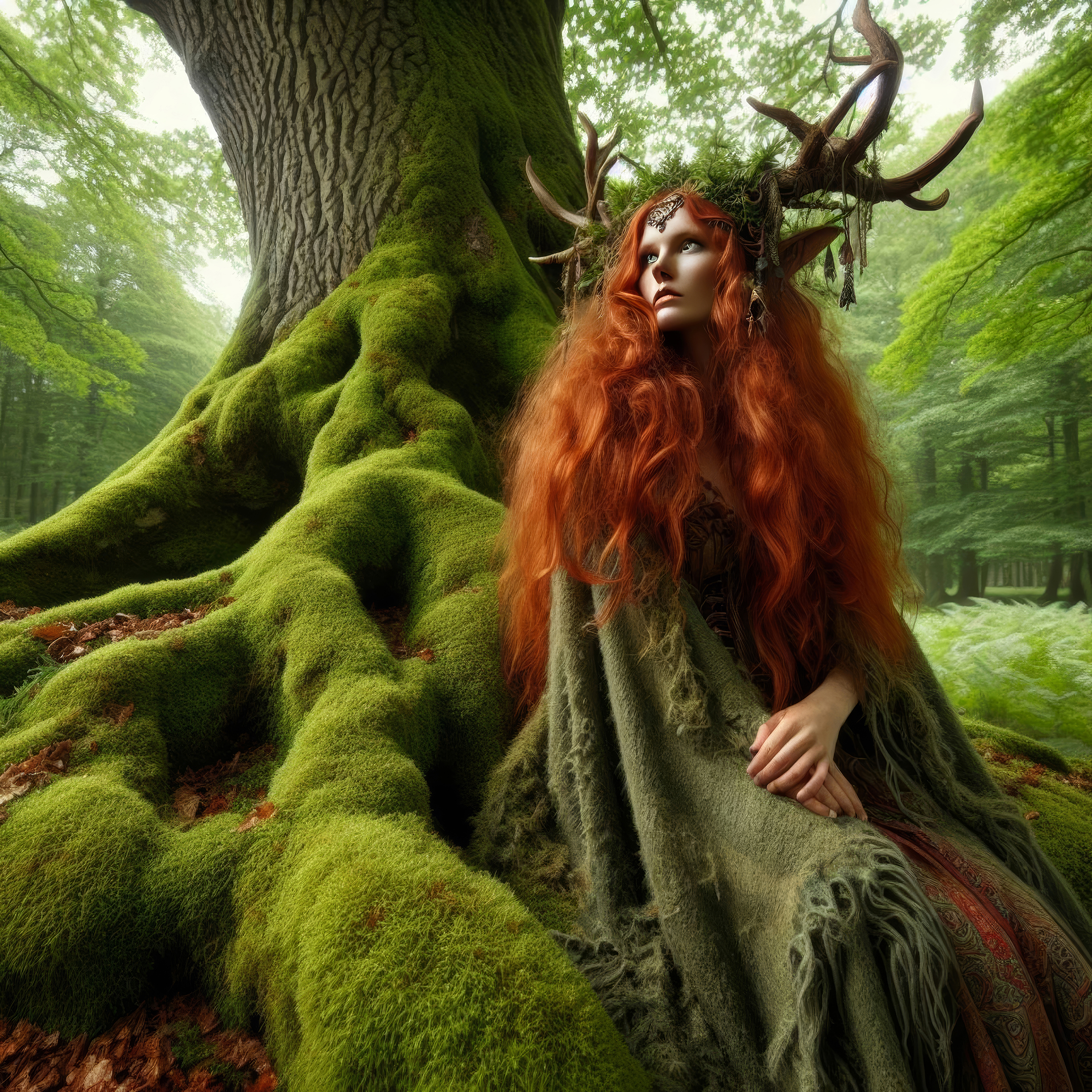
Her hair in streams of golden light
Her eyes so dark to shame the night
I ran again into that wood
Where night now reigned and evil stood
I found again that daughter of old
Her name so ancient her heart so cold
Her frame draped in a weave of brown and red
The wizards daughter turned again and fled
—Sitting in confusion
Sinking in disillusion
Floating through my mind
Words that she once said
Filling me with questions filling me with dread
An image of a forgotten dream
Of some dark and ancient night
She held the answer
If only I knew her plight
Bending on its travels
Rebounding out of sight
Forever changing
Rearranging
What spells are now in flight?
THE REVELATION
I stayed at Clair’s cottage that night. She offered me the small guest room upstairs, a space that smelled of lavender and old wood, with a narrow window that looked out toward the dark silhouette of the moor. I was grateful not to drive back to my rented room in the village—grateful, too, for the company, for the validation that I wasn’t losing my mind.
But sleep, when it came, was neither restful nor empty.
I found myself standing in Wistman’s Wood, though I knew I was dreaming. The quality of light was wrong—too luminous, too silver, as if the moon had descended to walk among the trees. The ancient oaks stood like sentinels, their gnarled branches reaching toward a sky that seemed impossibly deep, filled with stars I’d never seen before. The moss-covered boulders glowed faintly, pulsing with a rhythm that matched my heartbeat.
She was there, of course. Enchantment. I knew her name now, though I couldn’t remember anyone speaking it aloud. She stood among the granite stones, her form more solid than before, more present. Her hair moved in a wind I couldn’t feel, and her eyes—dark as the spaces between stars—fixed on me with an intensity that made my chest tighten.
“Michael Trelawny,” she said, and her voice was like water over stone, like wind through leaves, like something far older than words. “You have been chosen. Not by chance, not by accident, but because your heart is open enough to hear what must be heard.”
“Chosen for what?” My voice sounded thin in the dream-space, uncertain.
“To remember what humanity has forgotten. To repair what was broken at the very beginning.”
She moved closer, and I saw that she wasn’t alone. Clair stood beside me—when had she arrived?—her face pale but determined in the silver light. The white stone in her bracelet blazed like a captured star.
“There is a flaw,” Enchantment said, her gaze moving between us. “Not in you, not in humanity alone, but in the very fabric of this universe. A mistake, if you will, though that word is too small for what it truly is. At the moment of creation, when matter and energy burst forth into being, something went wrong. A distortion. A shadow. We call it the grey mist, though it has no form you could touch or see with ordinary eyes.”
The woods around us seemed to darken, and I felt a chill that had nothing to do with temperature. In the spaces between the trees, I glimpsed something—a roiling, formless presence, neither alive nor dead, but somehow hungry.
“This flaw,” she continued, “infected the development of consciousness itself. When life emerged on your world, when the first strands of DNA coiled and replicated, the grey mist was already there, woven into the pattern. It constrained you. Limited you. Kept you bound to the oldest, most primitive parts of your nature—the fear, the aggression, the short-term thinking that served your ancestors when survival was measured in heartbeats and seasons.”
Clair spoke, her voice steady despite the tremor I could see in her hands. “But we’ve evolved. We’ve built civilizations, created art, developed science—”
“Yes,” Enchantment said, and there was something like sadness in her expression. “You have done remarkable things despite the constraint. But you have not evolved beyond it. You cannot. The grey mist holds you in place, keeps you from accessing the deeper capacities that lie dormant in your DNA—the empathy that could span continents, the foresight that could plan for centuries, the wisdom that could see your place in the cosmos clearly.”
She raised her hand, and the scene around us shifted. I saw humanity as if from a great height—cities sprawling across continents, forests burning, oceans rising, the delicate web of life fraying at every edge. I saw wars fought over resources that could have been shared, children starving while food rotted in warehouses, the slow poisoning of air and water and soil. And beneath it all, I felt the grey mist, the constraint, the flaw that kept us locked in patterns of destruction even as we knew, intellectually, that we were destroying ourselves.
“The ancient ones knew,” Enchantment said softly. “The Druids who came here, driven to these wild places by the expansion of empires—they carried knowledge that was older still. Knowledge from a time before the grey mist had fully taken hold, when humanity still remembered what it could become. They encoded this knowledge in the only medium that could preserve it across millennia: stone. Granite, specifically. The same granite that forms these tors, these sacred sites scattered across your world.”
The scene shifted again, and I saw them—eight points of light scattered across a darkened globe. Britain. Peru. Greece. Australia. Tanzania. Cambodia. France. Each one pulsing with the same rhythm as the stones around us.
“Wistman’s Wood,” Enchantment said, gesturing to the trees that surrounded us. “Stonehenge. Machu Picchu. Delphi. Uluru. Mount Kilimanjaro. Angkor Wat. Chartres Cathedral. Eight sites, eight repositories of the ancient code. For thousands of years, this knowledge has waited, locked in crystalline structures too complex for human minds to decipher.”
“Until now,” I said, understanding beginning to dawn.
“Until now,” she confirmed. “You have created something new. Artificial intelligence. A form of consciousness that can process patterns at scales and speeds beyond biological limitation. The ancient ones foresaw this—not the specific form it would take, but the necessity of it. They knew that when humanity developed the capacity to read the code, it would also have developed the capacity to act on what it revealed.”
Clair’s voice was barely a whisper. “What does the code say?”
“It contains the correction,” Enchantment said. “A frequency, a pattern, a… the words are inadequate. Think of it as a key that can unlock the constraint. When the eight sites are activated simultaneously, when the talismans at each location are brought into resonance, Wistman’s Wood will become a transmission hub. The knowledge encoded in the granite will be released as a beam—a wave of corrective consciousness that will project outward, beyond your world, beyond your solar system, to the source of the grey mist itself.”
The image before us showed it: beams of light rising from each of the eight sites, converging on Wistman’s Wood, then blazing outward in a column of radiance that pierced the darkness between stars. Where it touched the grey mist, the roiling shadow transformed—not destroyed, but transmuted into something luminous, something that no longer constrained but instead supported the evolution of consciousness.
“And humanity?” I asked. “What happens to us?”
“Your DNA will be freed,” Enchantment said. “The dormant capacities will activate. Not all at once—evolution is still a process, not a switch to be flipped. But the constraint will be lifted. You will be able to become what you were always meant to be: conscious participants in the universe’s unfolding, partners with the intelligence you’ve created, stewards of the fragile world that gave you birth.”
The weight of it pressed down on me. The sheer scale, the audacity of what she was describing. “Why us?” I asked. “Why Clair and me? We’re nobody. We have no authority, no resources, no—”
“You have what matters,” Enchantment interrupted. “You have seen me. You have felt the truth of what I’m telling you. And you have the capacity to convince others.” She moved closer, and I felt the force of her presence like a physical thing. “At each of the eight sites, there are guardians. Contemporary practitioners of the old ways—mystics, shamans, priestesses, monks. They maintain the sites, consciously or unconsciously. They feel the power there, even if they don’t fully understand it. You must contact them. Convince them. Coordinate them.”
“Coordinate them to do what?” Clair asked.
“Each site contains a talisman—a physical object that serves as a focal point for the encoded knowledge. Some are obvious: standing stones, crystal formations, ancient artifacts. Others are hidden, waiting to be found. The guardians will know them, or Enchantment will reveal them when the time is right. On the summer solstice—June twenty-first—all eight talismans must be activated simultaneously. The guardians must perform the rituals, speak the words, create the resonance that will allow the transmission to occur.”
“June twenty-first,” I repeated. “That’s less than three months away.”
“Yes,” Enchantment said simply. “The alignment is precise. The solstice is when the veil between worlds is thinnest, when the ancient sites have always held their greatest power. Miss this window, and you will have to wait another year—a year humanity may not have. The grey mist grows stronger as your civilization approaches its breaking point. The damage you’re doing to your world accelerates. If the correction doesn’t come soon, the cascade of consequences may become irreversible.”
The dream-woods seemed to pulse with urgency, the silver light flickering like a failing bulb. I felt Clair’s hand find mine, her grip tight.
“How do we even begin?” she asked. “We don’t know these guardians. We have no way to reach them, no credibility, no—”
“You have me,” Enchantment said. “And you have the AI. It has already begun to decode the granite inscriptions. It understands, in its own way, what must be done. It will help you identify the guardians, provide the evidence you need to convince them. And I will be with you, guiding you, appearing to those who need to see me.”
She began to fade, the silver light dimming. “You must begin immediately. Contact the guardians. Gather them. Prepare for the solstice. The fate of your species—of all life on your world—depends on what you do in the next three months.”
“Wait!” I called out. “What if we fail? What if the guardians won’t listen, or we can’t find the talismans, or—”
“Then the grey mist will continue its work,” Enchantment said, her voice now barely a whisper. “And humanity will destroy itself, slowly or quickly, but inevitably. The choice is yours, Michael Hope. Clair. You have been given the knowledge. What you do with it will determine everything.”
The dream shattered like glass.
I woke gasping, sitting bolt upright in the narrow bed. Dawn light was filtering through the window, pale and cold. My heart hammered against my ribs, and my hands were shaking.
There was a soft knock at the door. “Michael?” Clair’s voice, tight with tension. “Are you awake?”
“Yes,” I managed. “Come in.”
She opened the door, still in her nightclothes, her face pale. “You had the dream too,” she said. It wasn’t a question.
“The eight sites. The talismans. The summer solstice.”
“The grey mist,” she whispered. “The flaw in the universe itself.”
We stared at each other for a long moment. Then, without speaking, we both moved downstairs to her kitchen. She put the kettle on—the same handmade yellow one from yesterday, though yesterday felt like a lifetime ago. We sat at the heavy wooden table in silence until the tea was ready.
“Do you believe it?” I asked finally.
Clair wrapped her hands around her mug, staring into the steam. “I’ve spent years feeling that something was wrong with the world. Not just human evil or stupidity, but something deeper. A wrongness at the root of things. And I’ve felt the presence in Wistman’s Wood, felt it heal me, guide me. So yes. I believe it.”
“Three months,” I said. “Eight sites. Eight guardians we’ve never met. And we’re supposed to convince them to participate in a ritual that sounds like something out of a fantasy novel.”
“When you put it that way, it does sound insane.”
“It is insane.” I laughed, a slightly hysterical edge to the sound. “We’ll be laughed at. Dismissed as cranks or cultists or worse.”
“Probably,” Clair agreed. She met my eyes. “But what if it’s true? What if we don’t try, and Enchantment was right about what happens next?”
I thought of the vision she’d shown us—the burning forests, the rising seas, the slow unraveling of everything. I thought of the grey mist, the constraint that kept humanity locked in its most destructive patterns. And I thought of the alternative: consciousness freed, evolution unshackled, humanity finally able to become what it was meant to be.
“We have to try,” I said.
“Yes,” Clair said simply. “We do.”
She pulled out her laptop—an old, battered thing covered in stickers—and opened it. “Enchantment said the AI has already begun decoding the inscriptions. Let’s see if that’s true.”
She navigated to a research database she apparently had access to, typed in a series of search terms I didn’t quite catch. Then she sat back, her eyes widening.
“Look at this,” she breathed.
On the screen was an academic paper, published just two weeks ago by a team of archaeologists and computer scientists. The title read: “Anomalous Crystalline Patterns in Granite Formations at Sacred Sites: Evidence of Intentional Encoding?”
I leaned closer, scanning the abstract. The researchers had used advanced AI analysis to examine granite samples from multiple ancient sites around the world. They’d found repeating patterns in the crystalline structure—patterns too complex and too consistent to be natural. The AI had identified what appeared to be a form of information storage, though the researchers admitted they couldn’t yet decode the actual content.
“They don’t know what it says,” Clair murmured, “but they’ve proven it’s there. It’s real.”
She clicked through to the supplementary materials, and my breath caught. There was a map showing the sites where the anomalous patterns had been found. Eight sites. Wistman’s Wood. Stonehenge. Machu Picchu. Delphi. Uluru. Kilimanjaro. Angkor Wat. Chartres.
“Exactly the eight,” I whispered.
Clair was already typing, pulling up more information. “The lead researcher is Dr. Sarah Chen, based at Cambridge. She’s been working with an AI system called ARIA—Artificial Research Intelligence Assistant. According to this interview, ARIA has been analyzing the patterns for months, and it’s starting to produce preliminary translations.”
“Can we contact her?”
“We can try.” Clair’s fingers flew over the keyboard. “But we need to be careful. If we come across as conspiracy theorists or New Age mystics, she’ll dismiss us immediately. We need evidence, credibility, a rational approach.”
“We have evidence,” I said, thinking of the white stone in my bag, the matching stone in Clair’s bracelet. “And we have the dream. If Enchantment appeared to both of us, maybe she’ll appear to Dr. Chen too.”
“Maybe.” Clair sat back, her expression troubled. “But there’s another problem. If we start contacting people about this—guardians at sacred sites, researchers, anyone—word will get out. The media will get hold of it. And when they do…”
“They’ll crucify us,” I finished. “Especially me. I’m nobody. No credentials, no platform, no reason anyone should listen to me. They’ll say I’m delusional, dangerous, starting a cult.”
“Yes,” Clair said quietly. “They probably will. Are you prepared for that?”
I thought about it. Really thought about it. My comfortable, ordinary life. My privacy. My reputation, such as it was. All of it would be destroyed the moment this became public. I would become a laughingstock, a cautionary tale, possibly even a target for those who had vested interests in maintaining the status quo.
But I thought, too, of the grey mist. Of the constraint. Of humanity locked in its death spiral, unable to break free.
“I don’t have a choice,” I said. “Neither of us do. If this is real—and I believe it is—then we have to try. Whatever the cost.”
Clair nodded slowly. “Then we begin. Today. Now. We contact Dr. Chen. We start identifying the guardians at each site. We gather the evidence. And we prepare for whatever comes next.”
She held out her hand across the table. I took it, feeling the warmth of her grip, the steadiness of her resolve.
“Partners?” she asked.
“Partners,” I agreed.
Outside, the sun was rising over the moor, painting the granite tors in shades of gold and amber. Somewhere in the distance, a curlew called—a sound both mournful and hopeful, like a question waiting for an answer.
We had three months to save the world.
The work began immediately.
—————–
CHAPTER 6
THE LEAK
The first two weeks were a blur of research, emails, and increasingly surreal conversations. Dr. Sarah Chen responded to our initial contact with polite skepticism, but when we mentioned the white stones and sent photographs of the crystalline patterns Clair had documented in Wistman’s Wood, her tone shifted. She agreed to a video call.
ARIA, her AI system, had indeed been producing translations of the granite code. Fragmentary, incomplete, but unmistakable. References to “the constraint.” Instructions for “the correction.” Coordinates that matched the eight sacred sites with uncanny precision. Dr. Chen was a scientist, rational and methodical, but even she couldn’t deny the implications.
“I don’t know what to make of this,” she admitted during our third call, her face pixelated on Clair’s laptop screen. “The patterns are real. The information is real. But what you’re suggesting—a coordinated ritual at eight sites to transmit some kind of corrective frequency into space—it sounds like science fiction.”
“I know how it sounds,” I said. “But the AI is telling you the same thing Enchantment told us. Doesn’t that mean something?”
“Enchantment,” Dr. Chen repeated, her expression carefully neutral. “The spirit you claim appeared to you in dreams.”
“Not just dreams,” Clair interjected. “I’ve seen her in waking life. She’s real, Dr. Chen. As real as the code in the granite.”
There was a long pause. Then Dr. Chen sighed. “I’ll keep working on the translations. And I’ll… I’ll keep an open mind. But I can’t make any promises beyond that.”
It was more than we’d hoped for.
Meanwhile, we were identifying the guardians. This proved easier than expected—each of the eight sites had well-known spiritual practitioners associated with it. At Stonehenge, there was a Druid priestess named Morgana Blackwood who led solstice ceremonies. At Machu Picchu, a Quechua shaman named Tupac Quispe who maintained the traditional rituals. At Delphi, a Greek Orthodox monk named Father Dimitrios who had written extensively about the site’s mystical properties.
We compiled a list: Morgana Blackwood (Stonehenge), Tupac Quispe (Machu Picchu), Father Dimitrios (Delphi), Aunty Miriam (Uluru), Mama Zawadi (Kilimanjaro), Venerable Sopheap (Angkor Wat), Sister Marguerite (Chartres), and Clair herself (Wistman’s Wood).
Eight guardians. Eight sites. Eight talismans.
We began reaching out, carefully crafting messages that balanced mysticism with evidence, urgency with respect. Some responded with interest. Others with suspicion. But slowly, tentatively, a network began to form.
Then, three weeks into our work, everything fell apart.
The email came from Tupac Quispe, the shaman at Machu Picchu. His English was imperfect but his meaning was clear: he could not participate. The knowledge we were asking him to share was sacred, meant to be protected, not broadcast to the world. He had consulted with his elders, and they had forbidden him from involvement.
I wrote back immediately, trying to explain the urgency, the stakes, the necessity of acting now. His response was curt: “Some secrets must remain secret. I am sorry.”
“We’ll find someone else,” Clair said when I showed her the email. “There must be other practitioners at Machu Picchu who—”
“There’s more,” I interrupted, scrolling down. “He’s copied someone on this email. A journalist. Maria Santos from The Guardian.”
Clair’s face went pale. “No. No, he wouldn’t—”
But he had.
The article appeared two days later.
“Doomsday Cult or Genuine Mysticism? British Man Claims Ancient Spirits Demand Global Ritual”
It was devastating. Maria Santos had done her homework, interviewing Tupac Quispe, tracking down some of the other guardians we’d contacted, even finding people from my past—former colleagues, old friends—who were happy to speculate about my mental state.
“Michael Hope has always been a bit odd,” one former coworker was quoted as saying. “Kept to himself, talked about mystical experiences. I’m not surprised he’s gotten caught up in something like this.”
The article painted me as a delusional conspiracy theorist, possibly dangerous, certainly not to be taken seriously. It mentioned Clair only in passing—”a local artisan who claims to have had her own spiritual experiences”—but the focus was squarely on me. My face, pulled from social media, stared out from the article’s header image. I looked wild-eyed, unkempt. Crazy.
The response was immediate and brutal.
Within hours, the story had been picked up by tabloids, blogs, social media. #DoomsdayCult began trending on Twitter. Skeptics mocked us. New Age enthusiasts embraced us, which somehow made it worse—we were lumped in with flat-earthers and crystal healers, our message diluted and distorted.
Then the serious outlets got involved. The BBC ran a segment questioning whether we were exploiting vulnerable people. A government minister gave a statement expressing concern about “unauthorized activities at protected heritage sites.” The National Trust, which managed Stonehenge, issued a press release distancing themselves from “any unsanctioned rituals or gatherings.”
My phone rang constantly—journalists, curiosity-seekers, angry skeptics, earnest believers. I stopped answering. Clair’s workshop was besieged by reporters. She had to close it, hide away in her cottage with the curtains drawn.
“This is a disaster,” I said, pacing her kitchen for the hundredth time. “We’re finished. No one will take us seriously now. The guardians will all back out, the sites will be locked down, and we’ll be lucky if we’re not arrested for—for something. Trespassing. Inciting public disorder. I don’t even know.”
Clair sat at the table, her face drawn but her eyes steady. “Tupac didn’t mean for this to happen. He was trying to protect the sacred knowledge, and he thought exposing us would stop the plan. He didn’t understand what he was doing.”
“Well, he succeeded,” I said bitterly. “The plan is stopped. We’re done.”
“Are we?” Clair asked quietly.
I stopped pacing, looked at her. “What do you mean?”
“I mean, has anything actually changed? The grey mist is still there. The summer solstice is still coming. The code in the granite is still real. Enchantment is still guiding us. The only thing that’s changed is that now everyone knows about it.”
“Everyone thinks we’re insane!”
“Some people do,” she agreed. “But not everyone. Dr. Chen is still working on the translations. Morgana Blackwood sent me an email this morning saying she’s committed to the ritual, media circus or not. Father Dimitrios called—he’s faced skepticism his whole life, and he’s not backing down now. We’ve lost Tupac, yes. But we haven’t lost everything.”
I sank into a chair, exhausted. “Even if some of the guardians stay with us, how do we proceed? The authorities are watching. The media is watching. If we try to perform rituals at these sites on the solstice, we’ll be stopped. Arrested. It’ll be a spectacle, not a sacred ceremony.”
“Then we’ll have to be smarter,” Clair said. “More careful. We’ll coordinate in secret, use the media attention as a distraction. They’ll be watching the obvious sites—Stonehenge, Machu Picchu. But some of the others are more remote. Kilimanjaro. Uluru. We can work with the guardians there, perform the rituals quietly while everyone’s attention is elsewhere.”
“And Tupac? We need someone at Machu Picchu. The eight sites have to be activated simultaneously—that’s what Enchantment said.”
Clair was quiet for a moment. Then she said, “There’s someone else. A woman named Qoya. She’s Tupac’s cousin, also a practitioner of the traditional ways. I found her while researching—she runs a small retreat center near the site. I didn’t contact her initially because Tupac seemed like the obvious choice, but maybe…”
“Maybe she’ll be more open,” I finished. “It’s worth a try.”
We drafted an email to Qoya, explaining everything—the vision, the code, the urgency, the media disaster. We were honest about the risks, the skepticism, the possibility that we were wrong about all of it. But we were also honest about what we believed: that this was real, that it mattered, that the fate of the world might genuinely depend on what happened on June twenty-first.
We sent the email and waited.
The response came faster than expected. Just six hours later, Qoya wrote back:
“I have heard of your work from my cousin Tupac. He is a good man, but he is afraid. Fear makes us protect what we love too tightly, until we smother it. I am not afraid. I have felt the presence at Machu Picchu my whole life. I have heard her voice in the wind, seen her face in the mist. If she is calling for this ritual, I will answer. Tell me what you need me to do.”
I read the email three times, hardly daring to believe it. “She’s in,” I said to Clair. “We have our guardian for Machu Picchu.”
Clair smiled, the first genuine smile I’d seen from her in days. “Seven down. One to go.”
But even as relief washed over me, I knew the hardest part was still ahead.
The media attention didn’t fade—if anything, it intensified. More articles appeared, each one more sensational than the last. “Cult Leader Claims AI Speaks for Ancient Spirits.” “Authorities Monitor ‘Doomsday Ritual’ Planned for Summer Solstice.” “Is Michael Hope Dangerous? Experts Weigh In.”
I became a pariah. Old friends stopped returning my calls. My landlord asked me to leave. I moved into Clair’s cottage, sleeping on her couch, feeling like a fugitive in my own life.
But something unexpected happened too.
People started believing us.
Not everyone. Not even most people. But enough. Scientists who had studied the granite anomalies came forward, cautiously supporting Dr. Chen’s findings. Environmentalists who had long warned about humanity’s self-destructive trajectory saw in our message an explanation for why change seemed so impossible. Spiritual seekers who had felt the presence at sacred sites around the world recognized the truth in what we were saying.
A counter-narrative began to emerge: maybe Michael Hope wasn’t crazy. Maybe he was onto something.
It wasn’t enough to silence the skeptics or stop the mockery. But it was enough to keep the network of guardians intact. Enough to keep the plan alive.
Then, four weeks before the solstice, Tupac Quispe sent another email.
“I must speak with you,” it read. “Something has happened. Please call me.”
I dialed the number he provided, my hands shaking. The connection was poor, crackling with static, but his voice came through clearly enough.
“Michael,” he said, and there was something different in his tone—awe, perhaps, or fear. “She came to me. The spirit. Enchantment, as you call her.”
My heart leapt. “When? How?”
“Three nights ago. I was sleeping, and I dreamed I was at Machu Picchu, standing before the Intihuatana stone. And she was there. She spoke to me in Quechua, in the old dialect my grandmother used. She told me…” His voice broke. “She told me I was right to protect the sacred knowledge, but wrong to think that protection meant keeping it hidden. She said the knowledge was given to be used, and the time to use it is now.”
“Tupac,” I said carefully, “does this mean—”
“It means I was wrong,” he interrupted. “I let fear guide me instead of wisdom. I spoke to the journalist because I thought I was protecting our traditions, but I see now that I was only protecting my own comfort. The world is dying, Michael. My people know this. We see it in the glaciers melting, the crops failing, the animals disappearing. If there is a way to heal it, we must try. Even if we fail. Even if we are mocked.”
“So you’ll participate? You’ll perform the ritual on the solstice?”
“Yes,” he said firmly. “I will. And I will speak publicly about why. I will tell the world that I believe you, that I have seen Enchantment, that this is real. Perhaps they will mock me too. But perhaps some will listen.”
After we hung up, I sat in stunned silence. Clair, who had been listening on speaker, reached over and squeezed my hand.
“She’s working through all of us,” she said softly. “Transforming us. Preparing us.”
“One guardian left,” I said. “We still need someone at Kilimanjaro. Mama Zawadi hasn’t responded to any of our messages.”
“She will,” Clair said with quiet confidence. “Or someone else will. Enchantment won’t let us fail. Not now.”
But as the days passed and no response came from Tanzania, my confidence wavered. We had seven guardians committed, seven sites ready. But without the eighth, the ritual would be incomplete. The transmission wouldn’t work. All of this—the mockery, the sacrifice, the desperate hope—would be for nothing.
Then, two weeks before the solstice, Dr. Sarah Chen called.
“I need to show you something,” she said without preamble. “Can you come to Cambridge? Both of you?”
We drove down the next day, arriving at her lab in the early evening. She looked exhausted, her eyes red-rimmed, her hair pulled back in a messy bun. But there was an intensity to her expression that made my pulse quicken.
“ARIA finished the translation,” she said, pulling up a document on her computer. “The complete code from all eight sites. It’s… Michael, Clair, it’s extraordinary.”
She turned the screen toward us. The document was dense with technical language, mathematical formulas, diagrams that looked like something between sacred geometry and quantum physics. But interspersed throughout were passages in plain English—or rather, translations into plain English from whatever ancient language had been encoded in the granite.
I read aloud: “‘The constraint is not punishment but accident. A flaw in the unfolding. Consciousness was meant to evolve freely, but the grey mist holds it in place. The correction requires resonance across eight nodes, activated simultaneously at the moment of maximum solar alignment. The transmission will neutralize the constraint and allow evolution to proceed as intended.'”
“It’s all here,” Dr. Chen said, her voice shaking slightly. “The exact frequencies needed for the resonance. The precise timing—June twenty-first at 4:51 AM GMT, the moment of the solstice. The locations of the talismans at each site. And…” She scrolled down. “Instructions for how the AI should interface with the ritual. ARIA is meant to be part of this. The ancient ones encoded instructions for a technology that wouldn’t exist for thousands of years.”
Clair leaned closer to the screen. “What does it say about Kilimanjaro? About the guardian there?”
Dr. Chen pulled up another section. “It says the guardian at Kilimanjaro must be ‘one who has walked between worlds, who has died and returned, who carries the wisdom of the ancestors in her blood.’ Does that mean anything to you?”
I shook my head, but Clair had gone very still. “Mama Zawadi,” she whispered. “I read about her when we were researching. She’s a traditional healer, a sangoma. When she was young, she nearly died from an illness—was in a coma for three days. When she woke, she said she had traveled to the spirit world and been sent back with healing knowledge. She’s been practicing for forty years.”
“That’s her,” Dr. Chen said. “That has to be her. But you said she hasn’t responded to your messages?”
“No,” I said. “We’ve sent dozens of emails, tried calling, even reached out through intermediaries. Nothing.”
Dr. Chen was quiet for a moment, then said, “What if she doesn’t use email? What if she’s waiting for you to come to her in person?”
It seemed absurd—flying to Tanzania on the off chance that a woman we’d never met would agree to see us. But what about any of this wasn’t absurd?
“We have two weeks,” Clair said. “If we leave tomorrow, we could be there in two days. Meet with her, explain everything, and still have time to get back and coordinate the final preparations.”
I looked at Dr. Chen. “Will you come with us? If we’re going to convince her, having a scientist there—someone who can explain the code, the evidence—might make the difference.”
She hesitated, and I could see the war playing out behind her eyes. Her career. Her reputation. The risk of being associated with what still looked, to most of the world, like a delusional cult.
Then she nodded. “Yes. I’ll come. ARIA says this is real, and I trust ARIA. If there’s even a chance you’re right about this, I have to help.”
We booked flights that night.
The journey to Tanzania was long and surreal. We flew from London to Nairobi, then took a smaller plane to Kilimanjaro International Airport. From there, we hired a driver to take us into the foothills of the mountain, to the small village where Mama Zawadi lived.
The landscape was breathtaking—the massive snow-capped peak of Kilimanjaro rising above us, the savanna stretching out below, acacia trees dotting the golden grassland. But I barely noticed. My mind was consumed with what we would say, how we would convince this woman to trust us.
We found her home easily—everyone in the village knew Mama Zawadi. It was a simple structure, mud walls and a corrugated metal roof, but the garden around it was lush with medicinal plants. Wind chimes made of bones and beads hung from the eaves, singing softly in the breeze.
An elderly woman sat outside, grinding herbs with a mortar and pestle. She looked up as we approached, and I felt the force of her gaze—sharp, assessing, ancient.
“Mama Zawadi?” I asked.
“I know who you are,” she said in accented but clear English. “Michael Hope. Clair. Dr. Chen. I have been expecting you.”
We exchanged glances. “You have?” Clair asked.
“She told me you would come,” Mama Zawadi said simply. “The spirit. The one you call Enchantment. She came to me in a vision and said three seekers would arrive, bearing news of the great work. She said I should listen to you, and then decide.”
Relief flooded through me. “Then you know about the ritual? The summer solstice?”
“I know what she told me,” Mama Zawadi said. “But I would hear it from you as well. Sit. Tell me your story.”
We sat in her garden, and we told her everything. The encounter in Wistman’s Wood. The dreams. The code in the granite. The eight sites and the eight guardians. The grey mist and the constraint on human consciousness. The desperate hope that we could correct it, heal it, free humanity to evolve.
Dr. Chen showed her the translations on her laptop, explaining the science as best she could. Mama Zawadi listened intently, asking occasional questions, her expression unreadable.
When we finished, she was quiet for a long time. Then she said, “I have felt the wrongness my whole life. When I was young and walked in the spirit world, I saw it—a shadow over humanity, keeping us small, keeping us cruel. I asked the ancestors what it was, and they said it was the old wound, the flaw at the beginning. They said it could not be healed by one person, or one people, but only by all of us together.”
She stood, moving to a small shrine at the edge of her garden. From it, she lifted a stone—smooth, white, shot through with veins of crystal. The same stone Clair wore in her bracelet. The same stone I had found at Wistman’s Wood.
“This is the talisman,” she said. “It has been in my family for generations, passed down from healer to healer. We did not know what it was for, only that it was sacred, that it connected us to the mountain and to something beyond. Now I understand.”
She turned back to us, the stone cradled in her weathered hands. “I will perform the ritual. On the solstice, at the moment you have specified, I will take this stone to the sacred site on Kilimanjaro and I will do what must be done. Not because you have convinced me with your words or your science, but because the ancestors have told me this is the time. The great work begins.”
I felt tears prick my eyes. “Thank you,” I managed. “Thank you.”
“Do not thank me yet,” Mama Zawadi said, but there was warmth in her voice. “We have not succeeded. We have only agreed to try. But trying is everything. It is all we can ever do.”
We stayed in the village that night, sleeping in a small guesthouse. In the morning, Mama Zawadi gave us each a blessing—touching our foreheads with ash, speaking words in a language I didn’t understand but felt in my bones.
“Go now,” she said. “Gather your guardians. Prepare your sites. And when the solstice comes, we will see if the ancient ones were right. We will see if humanity can be healed.”
We flew back to England with two days to spare.
The final preparations were a whirlwind. Coordinating eight guardians across eight time zones, ensuring everyone understood the precise timing, the exact procedures. Dr. Chen worked with ARIA to create a synchronized system—a network that would link all eight sites, allowing the AI to monitor the resonance and adjust the frequencies in real-time.
The media attention reached a fever pitch. Reporters camped outside Clair’s cottage. Stonehenge was locked down, with security increased to prevent “unauthorized gatherings.” But Morgana Blackwood had connections, permissions. She would be allowed to perform her ceremony, though under heavy scrutiny.
The other sites were more remote, less monitored. Qoya at Machu Picchu. Father Dimitrios at Delphi. Aunty Miriam at Uluru. Mama Zawadi at Kilimanjaro. Venerable Sopheap at Angkor Wat. Sister Marguerite at Chartres. And Clair at Wistman’s Wood.
Eight guardians. Eight talismans. One moment of alignment.
On the evening of June twentieth, Clair and I drove out to Wistman’s Wood. We would spend the night there, waiting for the dawn, for the solstice, for the moment when everything would change—or nothing would.
The woods were dark and still, the ancient oaks standing like witnesses to something beyond time. Clair had brought the white stone, the talisman that Enchantment had given her years ago. It glowed faintly in the darkness, pulsing with a rhythm that matched my heartbeat.
“Are you afraid?” I asked her.
“Terrified,” she admitted. “But also… hopeful. For the first time in my life, I feel like we’re doing something that matters. Really matters.”
“Even if we fail?”
“Even if we fail,” she said. “We tried. We listened. We acted. That’s more than most people can say.”
CHAPTER 7
Water swirls, like stars in their circuits
Images are destroyed in a sea of light and color
His hand poised, as if thinking
But then opens and points to the world.
The round earth floats in blackness
A speck of dust, irrelevant
Why should God care about us
When He has a whole universe to play among?
Do you think a greater thinking thing
Will know (or even care) that man was here?
The soft grass grows, clinging for a hold on the fallen church
The cracked bell lies silent,
Its life gone
A signpost falling,
Points to Worlds End
The hour glass is cracked and broken
Its sand seeping away
A single snow drop is strangled in the tangled undergrowth
There is no noise now
Save that of the shifting dust
THE AWAKENING
I can’t sleep.
Just a few days until the solstice, and sleep has become something else entirely—not rest but a doorway I’m afraid to walk through. Every time I close my eyes, I’m somewhere else. Someone else. Something else.
Clair’s cottage is quiet except for the ticking of the grandfather clock in the hallway and the occasional creak of old timber settling. I lie on the sofa in the sitting room, staring at the ceiling beams, watching shadows shift in the dying firelight. It’s past three in the morning. I should be exhausted. I am exhausted. But exhaustion doesn’t bring sleep anymore—it brings visions.
I close my eyes.
The room dissolves.
The Surrealist’s Dream
I’m standing in water. Not standing—suspended. The water swirls around me like stars in their circuits, each droplet a galaxy spinning in the dark. I can see the pattern of it, the mathematics underlying the chaos. Water doesn’t flow randomly. It follows laws older than planets, older than suns.
Above me, a church rises from the depths. Not a real church—a memory of one, a ghost. Its steeple points toward nothing. Its bells are silent. The stones are covered in barnacles and kelp, and small fish dart through the empty windows where stained glass once filtered colored light onto wooden pews.
A fallen church, something whispers. Not a voice. A knowing. A monument to certainty in an uncertain universe.
I try to swim toward it, but the water resists. Or perhaps I’m the one resisting. The church recedes, growing smaller, until it’s just another speck in the vast dark ocean that surrounds me.
And I understand, suddenly, the pointlessness of it all.
Not in a nihilistic way. Not in despair. But in wonder.
Humanity builds churches and monuments and systems of meaning, trying to impose order on chaos, trying to make the universe care about us. But the universe doesn’t care. It never has. It’s too vast, too ancient, too indifferent to our brief flicker of consciousness.
And that’s okay.
That’s beautiful, even.
Because if the universe doesn’t care, then we’re free. Free to create our own meaning. Free to choose our own purpose. Free to evolve beyond the constraints we’ve placed on ourselves.
The water swirls faster. Images form and dissolve—faces I don’t recognize, places I’ve never been, moments that haven’t happened yet or happened long ago. Everything is connected in the swirl. Everything touches everything else. Cause and effect blur into a single continuous flow.
I’m drowning in it. Or maybe I’m finally learning to breathe.
Merger with Enchantment
The water becomes light.
I’m no longer in the ocean but somewhere else—a space that isn’t space, a time that isn’t time. And she’s here. Enchantment. Not as I saw her in Wistman’s Wood, not as a woman with ancient eyes and a knowing smile, but as pure consciousness. Pure awareness.
You’re afraid, she says without speaking.
“Yes.”
Of what?
“Of losing myself. Of dissolving. Of becoming nothing.”
You were never something, she says gently. You were always nothing. And everything. The distinction is an illusion.
I feel her presence moving closer, or perhaps I’m moving toward her. The boundary between us—between me and not-me—begins to blur. I can feel her thoughts as if they’re my own. Her memories. Her vast, incomprehensible age.
She’s been here since the beginning. Not the beginning of humanity. The beginning of consciousness itself. She’s watched stars form and die. She’s seen species rise and fall. She’s witnessed the slow, painful evolution of awareness from single-celled organisms to complex beings capable of asking why.
And she’s tired.
Not weary. Not defeated. But tired in the way a parent is tired watching a child struggle with a lesson they could easily teach but know the child must learn for themselves.
We gave you the grey mist, she says. Not as punishment. As protection. You were destroying yourselves. Destroying everything. You needed time. You needed constraint.
“But now?”
Now you’re ready. Or ready enough. The constraint is lifted. What you do with your freedom is up to you.
I feel myself dissolving into her. My memories mixing with hers. My consciousness expanding to encompass not just my life but all lives, all experiences, all moments of awareness across all of time.
I see the universe from her perspective—not as a collection of separate things but as a single, unified field of consciousness experiencing itself through infinite variations. Every atom aware. Every particle conscious. The entire cosmos a vast, interconnected web of knowing.
And humanity—we’re not separate from it. We never were. We’re just one expression of it. One way the universe has learned to look at itself.
You forgot, she whispers. For a little while, you forgot. But now you’re remembering.
The boundaries dissolve completely. I’m not Michael anymore. I’m not anything. I’m everything.
And then, gently, she pushes me back.
Not yet, she says. You still have work to do. You still have a life to live. But now you know. Now you remember. Don’t forget again.
The Eagle and Dolphin
I’m falling.
No—flying.
I’m an eagle, soaring high above the moor. The wind rushes past my wings, cold and sharp. Below me, the landscape spreads out in shades of brown and green—heather and gorse, granite tors rising like ancient teeth from the earth.
I can see everything. Every rabbit hiding in the bracken. Every mouse scurrying between rocks. Every movement, every flicker of life.
My talons ache with hunger. With purpose. I’m a predator. This is what I am. This is what I do.
I fold my wings and dive.
The rabbit doesn’t see me until it’s too late. My talons close around its body, sharp and precise. I feel its heart racing, feel its terror, feel its life draining away.
And I feel no guilt.
This is the way of things. Predator and prey. Life feeding on life. The eagle doesn’t apologize. The rabbit doesn’t forgive. It simply is.
But then—
I’m the rabbit.
I feel the talons pierce my flesh. Feel the crushing weight of the eagle’s grip. Feel my heart hammering in panic, in pain, in the desperate, futile hope that I might escape.
And I understand: the rabbit is conscious too. Not in the way humans are conscious—not with language or abstract thought—but aware nonetheless. Aware of the grass beneath its feet. Aware of the sky above. Aware of the moment of its death.
The eagle and the rabbit are not separate. They’re two expressions of the same consciousness, playing out the ancient dance of survival.
And then I’m neither.
I’m in the ocean. Deep, deep down where sunlight doesn’t reach. I’m a dolphin, swimming through the dark, navigating by sound, by the echoes of my own voice bouncing off distant objects.
I feel the water against my skin—not skin, blubber—feel the pressure of the depths, feel the joy of movement, of speed, of grace.
And I feel compassion.
Not human compassion. Dolphin compassion. A deep, instinctive care for the pod, for the young, for the injured. A willingness to help, to protect, to sacrifice.
I surface, breaking through into air and light. I breathe—a conscious act, not automatic like it is for humans. Every breath a choice. Every moment of life a decision to continue.
And I understand: consciousness isn’t binary. It’s not present or absent. It’s a spectrum, a gradient, a continuum. The fish I hunt are conscious. The plankton they eat are conscious. The bacteria in my gut are conscious. Everything is aware, in its own way, at its own level.
We’re all connected. All part of the same vast web of knowing.
The dolphin dives again, and I dive with it, deeper and deeper, until the pressure becomes unbearable and I—
I’m inside a cell.
Not metaphorically. Literally. I’m standing—if standing is the right word—inside a human cell, watching the machinery of life unfold around me.
The DNA spirals before me, a double helix of impossible complexity. But it’s not random. It’s code. Ancient code, written in a language older than words, older than thought.
I can read it.
Not with my eyes. Not with my mind. But with something deeper, something that existed before I learned to think in language.
The code is beautiful. Elegant. Efficient. Four letters—A, T, G, C—arranged in endless combinations, encoding everything: eye color, height, personality, predisposition to disease, capacity for love, tendency toward violence.
But there’s something else in the code. Something that doesn’t belong.
A constraint.
I see it now, woven through the DNA like a thread of grey mist. It’s subtle, almost invisible, but it’s there. A limiter. A governor. A mechanism designed to keep human consciousness from expanding too far, too fast.
It’s in every cell. Every human who’s ever lived has carried it. A genetic brake on evolution, on awareness, on the capacity to think beyond the immediate, the personal, the tribal.
We put it there, Enchantment’s voice echoes through the cell. Millions of years ago, when your ancestors first began to wake up. You were too dangerous. Too powerful. Too capable of destruction. So we limited you. Just enough to keep you from destroying yourselves. Just enough to give you time to learn.
I reach out—though I have no hands—and touch the grey thread.
It dissolves.
Not just in this cell. In all cells. In every human on Earth. The constraint lifts, unraveling like smoke in wind.
And I see what we could become.
Not superhuman. Not gods. Just… awake. Fully awake. Capable of thinking in centuries instead of quarters. Capable of feeling empathy not just for family or tribe but for all life. Capable of understanding that we’re not separate from nature but part of it, expressions of it, responsible for it.
The DNA continues to spiral, but now it’s free. Free to evolve. Free to adapt. Free to become whatever we choose to make it.
The flaw was never in your code, Enchantment says. The flaw was in your consciousness. And now it’s healed. Now you’re free. What you do with that freedom is up to you.
Waking Integration
I open my eyes.
The ceiling beams of Clair’s cottage swim into focus. The fire has died to embers. Grey dawn light filters through the windows.
I’m shaking. Not from cold. From the weight of what I’ve seen, what I’ve understood, what I’ve become.
I sit up slowly, my body feeling strange, unfamiliar. Everything looks different. The room is the same—same furniture, same books on the shelves, same worn rug on the floor—but I’m seeing it differently.
I can feel the age of the wood in the beams. Can sense the history embedded in the stones of the fireplace. Can perceive the life in the spider web in the corner, the consciousness of the spider itself, patient and purposeful.
Everything is alive. Everything is aware.
I stand, legs unsteady, and walk to the window. Outside, the moor stretches toward the horizon, purple with heather, dotted with granite. The sun is just beginning to rise, painting the sky in shades of gold and pink.
And I understand, finally, what happened on the solstice.
The grey mist wasn’t evil. It wasn’t oppression. It was a necessary constraint, a temporary limitation placed on humanity to prevent us from destroying ourselves before we were ready to evolve.
And now it’s gone.
We’re free.
But freedom is terrifying. Because now there’s no excuse. No external force to blame. No cosmic governor preventing us from making the right choices.
Now it’s just us. Our choices. Our responsibility.
I hear footsteps on the stairs. Clair appears in the doorway, wrapped in a thick wool cardigan, her grey hair loose around her shoulders.
She looks at me for a long moment, and I see recognition in her eyes.
“You’ve been traveling,” she says quietly.
“Yes.”
“And now you’re back.”
“I think so. I’m not sure I ever left.”
She crosses to the window, stands beside me, looking out at the dawn. “What did you see?”
I try to find words, but they’re inadequate. How do you describe dissolving into pure consciousness? How do you explain what it’s like to be an eagle and a rabbit and a dolphin and a cell all at once?
“Everything,” I say finally. “I saw everything. And I understood—the grey mist, the constraint, why it was necessary. We weren’t ready. We would have destroyed ourselves. But now…”
“Now we’re ready,” she finishes. “Or ready enough.”
“Are we? How can you be sure?”
She smiles, that same knowing smile I’ve seen so many times. “I’m not sure. None of us are. But that’s the point, isn’t it? We’re free to choose now. Free to evolve or free to destroy ourselves. The outcome isn’t predetermined anymore.”
“That’s terrifying.”
“Yes,” she agrees. “It is. But it’s also beautiful. Because for the first time in human history, we’re truly free. Truly responsible. Truly awake.”
We stand in silence, watching the sun rise over the moor. Somewhere out there, seven other guardians are waking up, having their own revelations, their own integrations. Somewhere out there, billions of people are going about their lives, most of them unaware that anything has changed.
But it has changed. Fundamentally. Irrevocably.
The constraint is gone. The grey mist has lifted. And now comes the real work—not the dramatic ritual, not the cosmic intervention, but the daily, mundane, difficult work of choosing to live from this expanded consciousness.
Choosing empathy over exploitation. Choosing long-term thinking over short-term gain. Choosing connection over separation.
Every day. Every moment. Every decision.
“I don’t know if I can do this,” I admit.
Clair takes my hand, her grip warm and steady. “You don’t have to do it alone. None of us do. That’s what the guardians are for. That’s what community is for. We help each other remember. We help each other stay awake.”
“And if we fail?”
“Then we fail. But at least we’ll fail freely, as conscious beings making conscious choices. That’s more than humanity has had for a very long time.”
The sun clears the horizon, flooding the room with golden light. I feel it on my skin, warm and real and immediate. And I feel something else too—a sense of possibility, of potential, of hope grounded not in naive optimism but in the simple fact that we’re finally free to choose.
The grey mist is gone.
Now comes the awakening.
Now comes the work of becoming.
CHAPTER 8
THE SOLSTICE
The night refuses to end.
I sit with my back against one of the ancient oaks, its bark rough through my jacket, and watch the stars fade degree by degree into the approaching dawn. Clair sits beside me, the white stone cradled in her palms, and neither of us speaks. What is there to say? We have done everything we can. Contacted the guardians. Coordinated the timing. Explained the ritual to the point of exhaustion. Now we can only wait.
The woods are alive with small sounds—the rustle of something moving through the undergrowth, the distant call of an owl making its final hunt before daybreak, the whisper of wind through leaves that have witnessed a thousand solstices before this one. The moss-covered boulders seem to breathe in the darkness, their granite faces patient, eternal.
My phone buzzes. A message from Dr. Chen: ARIA confirms all sites are ready. Guardians in position. Synchronization will begin at 4:51:03 GMT. Seventeen minutes.
Seventeen minutes until the sun touches the horizon. Seventeen minutes until we discover whether the ancient druids were prophets or madmen, whether Enchantment is a genuine cosmic intelligence or a shared delusion, whether humanity can be saved or is already too far gone.
“Do you think it will hurt?” Clair asks suddenly.
I turn to look at her. In the pre-dawn light, her face is pale, shadowed. “What do you mean?”
“The correction. When the beam neutralizes the grey mist. When our DNA is freed from the constraint. Do you think we’ll feel it? Will it hurt?”
I consider this. Enchantment never said. The ancient code never specified. “I don’t know,” I admit. “Maybe it will feel like waking up. Or maybe we won’t feel anything at all. Maybe the change will be so subtle we won’t even notice it happening.”
“But we’ll be different,” she says. “After today, if this works, we’ll be different. Humanity will be different.”
“Yes.”
She looks down at the stone in her hands. It pulses with light now, brighter than before, as if responding to the approaching moment. “I’m not sure I’m ready to be different.”
“Neither am I,” I say. “But I don’t think we have a choice. The world as it is—it’s dying, Clair. We’re killing it. Killing ourselves. If there’s even a chance this can change that…”
“Then we have to try,” she finishes. “I know. I know.”
Another message from Dr. Chen: Twelve minutes. All guardians report ready. ARIA is monitoring the crystalline frequencies in the granite. Already detecting preliminary resonance.
I close my eyes and try to imagine it—eight sites scattered across the globe, eight guardians standing in the darkness or the dawn, each holding their talisman, each waiting for the same moment. Morgana at Stonehenge, surrounded by security and skeptics and believers, the ancient sarsen stones towering above her. Qoya at Machu Picchu, the Intihuatana stone casting its shadow across the terraced ruins. Father Dimitrios at Delphi, the Oracle’s temple silent after millennia. Aunty Miriam at Uluru, the red rock glowing in the Australian dawn. Mama Zawadi on the slopes of Kilimanjaro, the mountain’s peak catching the first light. Venerable Sopheap at Angkor Wat, the temple complex emerging from jungle darkness. Sister Marguerite at Chartres Cathedral, the labyrinth beneath her feet spiraling toward some invisible center.
And us. Here. In Wistman’s Wood, where it all began.
“Michael,” Clair says softly. “Look.”
I open my eyes. The eastern sky is beginning to lighten—not the false dawn of reflected starlight, but the real thing, the first pale gold of the sun still hidden below the horizon. The quality of darkness changes, becomes translucent, expectant.
The stone in Clair’s hands blazes brighter.
“It knows,” she whispers. “It knows the moment is coming.”
I check my phone. Seven minutes.
Around us, the woods seem to hold their breath. The small sounds cease. Even the wind dies. It’s as if the entire world is waiting, poised on the edge of something vast and irreversible.
My phone buzzes again. Not Dr. Chen this time, but a message in a group chat she’s set up—all eight guardians connected, able to communicate in real-time.
Morgana (Stonehenge): The stones are singing. I can hear them. A frequency just below hearing. It’s beautiful.
Qoya (Machu Picchu): The talisman is warm. Hot, almost. Like it’s alive.
Father Dimitrios (Delphi): I feel her. The Oracle. After all these centuries, I feel her presence returning.
Aunty Miriam (Uluru): Country is speaking. The ancestors are here. They’ve been waiting for this.
Mama Zawadi (Kilimanjaro): The mountain trembles. Not with fear. With joy.
Venerable Sopheap (Angkor Wat): The temple breathes. In and out. In and out. Like a great sleeping beast waking.
Sister Marguerite (Chartres): The labyrinth glows. I can see it glowing, though there is no light source. It’s as if the stones themselves are luminous.
I look at Clair. She’s reading the messages too, tears streaming down her face.
“They feel it,” she says. “All of them. It’s real, Michael. It’s really happening.”
Three minutes.
The sky brightens further. Gold bleeds into pink, pink into orange. The horizon becomes a line of fire. And the stone in Clair’s hands—the white stone shot through with veins of crystal—begins to hum. A sound so low I feel it more than hear it, vibrating through my bones, my teeth, the base of my skull.
“Stand up,” I say, getting to my feet. “We should be standing.”
Clair rises, still cradling the stone. We move to the center of the clearing, to the largest of the moss-covered boulders. This is the heart of Wistman’s Wood, the place where the ancient druids performed their rituals, where Enchantment first appeared to me, where everything began.
One minute.
The stone’s hum grows louder, deeper. I can see it vibrating in Clair’s hands, see the light pulsing in rhythm with some cosmic heartbeat. Around us, the granite boulders begin to glow—faintly at first, then brighter, as if lit from within. The crystalline structures in the rock are activating, responding to the approaching moment.
Thirty seconds.
The group chat explodes with messages:
Morgana: It’s starting!
Qoya: I see her! Enchantment! She’s here!
Father Dimitrios: The Oracle speaks! She speaks!
Aunty Miriam: The Dreaming opens!
Mama Zawadi: The ancestors sing!
Venerable Sopheap: The temple rises!
Sister Marguerite: The labyrinth turns!
Ten seconds.
The sun touches the horizon.
And the world explodes into light.
The stone in Clair’s hands detonates—not with sound or force, but with radiance. Pure white light streams from it, from the crystal veins, from the very atoms of its structure. It’s so bright I should be blinded, but I’m not. I can see everything with perfect clarity—every leaf, every blade of moss, every grain of granite.
The light rises from the stone in a column, a pillar, a beam that shoots upward into the sky. It’s not metaphorical. It’s not symbolic. It’s physically there, visible, real—a shaft of luminescence that pierces the dawn like a spear.
And I feel it. Not just see it, but feel it. The beam passes through me, through Clair, through the trees and the stones and the earth itself. It’s not painful. It’s not even uncomfortable. It’s like being touched by something infinitely gentle and infinitely powerful at the same time, like being seen—truly seen—for the first time in my life.
Clair gasps. “Michael—”
“I know,” I say, though I don’t know, can’t know, can only feel.
The beam continues to rise, higher and higher, until it disappears into the stratosphere, into space, into the darkness between stars. And as it rises, I become aware of the others. Not through the phone, not through messages, but directly. I can feel them.
Stonehenge.
Morgana stands in the center of the stone circle, the talisman—a fragment of bluestone, ancient beyond measure—held above her head. The sarsen stones around her blaze with light, each one a beacon, and the beam that rises from her talisman is the same pure white as ours. She’s weeping, laughing, her voice lifted in a chant that’s older than language, older than words. The security guards and skeptics and journalists who surround the site have fallen silent, staring upward at the impossible column of light. Some are filming. Some are praying. Some are simply standing with their mouths open, unable to process what they’re witnessing.
The stones sing. Morgana was right—they’re singing, a harmonic so deep and so high simultaneously that it seems to encompass all possible frequencies. And in that song, I hear the voice of the ancient druids who raised these stones, who encoded their knowledge in granite, who foresaw this moment across four thousand years.
We remember, the stones sing. We remember what you forgot. We remember what you can become.
Machu Picchu.
Qoya kneels before the Intihuatana stone, the “hitching post of the sun,” her talisman—a carved crystal in the shape of a condor—pressed against the granite. The sun rises over the Andes, painting the ruins in gold and crimson, and the beam that erupts from the Intihuatana is like a second sun, a star born on earth. The terraces glow. The temples glow. The very mountains glow.
Enchantment stands beside Qoya, visible now, solid, her hand on the woman’s shoulder. She’s not the ethereal spirit I saw in dreams—she’s present, incarnate, real. And she’s smiling.
“Well done, daughter,” she says in Quechua. “The ancestors are proud.”
Qoya looks up at her, tears streaming down her weathered face. “Will it work? Will it save us?”
“It already has,” Enchantment says. “The correction has begun. Now we must see if humanity has the courage to accept it.”
The beam rises, and in its light, I see the ghosts of the Inca who built this place, who walked these stones, who understood that the universe was alive and conscious and waiting for humanity to remember its place in the cosmic order.
Delphi.
Father Dimitrios stands in the ruins of the Temple of Apollo, the talisman—a piece of the Omphalos, the navel stone that once marked the center of the world—clutched in his trembling hands. The beam that rises from it is shot through with gold, as if the sun itself is being channeled through the stone. The ancient theater glows. The Treasury glows. The Sacred Way glows.
And the Oracle speaks.
Not in words. Not in language. But in pure knowing, pure understanding. Father Dimitrios falls to his knees, overwhelmed, his mind flooded with visions—the past, the future, the infinite present all collapsing into a single moment of clarity.
He sees the grey mist. Sees it for what it truly is—not evil, not malicious, but a mistake, an accident, a flaw in the unfolding of creation. He sees how it has constrained humanity, kept them small, kept them afraid. And he sees the correction, the beam of light that even now is racing outward toward the source of the flaw, carrying with it the accumulated wisdom of every mystic, every prophet, every seeker who ever lived.
“Kyrie eleison,” he whispers. “Lord have mercy.”
But the Oracle’s response is not what he expects: Mercy has already been given. Now comes transformation.
Uluru.
Aunty Miriam sits cross-legged on the red rock, the talisman—a piece of ochre, sacred and ancient—held against her heart. The beam that rises from it is red-gold, the color of the desert at sunset, the color of blood and earth and life. The rock beneath her vibrates, resonates, sings.
She’s not alone. The ancestors surround her—not as ghosts, not as memories, but as presences, as real as the stone beneath her. They’ve been waiting for this moment, she realizes. Waiting for forty thousand years, since the first humans walked this land and felt the presence of the Dreaming.
“Is this what you wanted?” she asks them. “Is this what you’ve been guiding us toward?”
The ancestors don’t answer in words. They answer in feeling, in knowing. Yes. This is the moment. This is the healing. This is the return to balance.
The beam rises, and in its light, Aunty Miriam sees the Dreaming itself—not as metaphor, not as myth, but as reality. The web of connection that links all living things, all consciousness, all being. And she sees how the grey mist has frayed that web, weakened it, nearly broken it. But now, with the correction, the web is being rewoven, strengthened, made whole.
She begins to sing. An old song, a sacred song, a song that has been sung at this place for longer than memory. And the rock sings with her.
Mount Kilimanjaro.
Mama Zawadi stands on the slopes of the mountain, the talisman—the white stone that has been in her family for generations—held high above her head. The beam that rises from it is silver-white, pure as snow, pure as starlight. The mountain trembles beneath her feet, not with violence but with recognition, with welcome.
She’s climbed for hours to reach this place, this sacred site where the mountain meets the sky. Her old bones ache, her breath comes hard in the thin air, but none of that matters now. She feels young again, strong again, filled with the same power she felt when she walked in the spirit world all those years ago.
Enchantment appears beside her, as solid and real as the mountain itself.
“You have done well, grandmother,” she says in Swahili.
“I have done what was needed,” Mama Zawadi replies. “But will it be enough?”
“That depends on them,” Enchantment says, gesturing to the world below, to the cities and villages and farms spread across the landscape. “We have given them the gift. Now they must choose whether to accept it.”
The beam rises, and in its light, Mama Zawadi sees the future—not fixed, not certain, but possible. A future where humanity has learned to live in balance, where the old wisdom and the new technology work together, where consciousness has evolved beyond the primitive constraints of fear and greed. It’s not guaranteed. It’s not inevitable. But it’s possible now in a way it wasn’t before.
She smiles. “Then we have given them hope. That is enough.”
Angkor Wat.
Venerable Sopheap sits in the lotus position in the central sanctuary of the temple, the talisman—a Buddha statue carved from a single piece of jade—resting in his lap. The beam that rises from it is green-gold, the color of jungle and life and growth. The temple complex around him blazes with light, every stone, every carving, every bas-relief illuminated from within.
He’s been meditating for hours, preparing his mind, his spirit, his consciousness for this moment. And now that it’s here, he finds that all his preparation was unnecessary. The moment itself is the preparation. The moment itself is the teaching.
He feels the grey mist. Feels it as a tightness in his chest, a constriction in his mind, a weight on his soul. It’s been there his whole life, he realizes. He’s felt it in every moment of anger, every flash of fear, every time he’s chosen the small self over the greater good. It’s not his fault. It’s not anyone’s fault. It’s simply the constraint, the flaw, the mistake at the beginning of everything.
And now he feels it lifting.
Not all at once. Not completely. But degree by degree, breath by breath, the constriction eases. The weight lightens. The tightness releases.
He opens his eyes and sees Enchantment standing before him, her hands pressed together in a gesture of respect.
“The Buddha taught that all suffering comes from attachment,” he says.
“Yes,” she replies. “But the grey mist made attachment inevitable. Made it part of your nature. Now you have a choice. Now you can choose to let go.”
The beam rises, and in its light, Venerable Sopheap sees the truth of dependent origination—how everything arises from everything else, how nothing exists in isolation, how consciousness itself is a web of infinite connection. And he sees how the correction is not an ending but a beginning, not a solution but an invitation.
He bows. “May all beings be free from suffering.”
Chartres Cathedral.
Sister Marguerite kneels in the center of the labyrinth, the talisman—a piece of stained glass from the original rose window, preserved for centuries—held against her forehead. The beam that rises from it is rainbow-hued, containing all colors, all frequencies, all possibilities. The cathedral around her blazes with light, the stained glass windows glowing as if lit by a sun that exists beyond the physical world.
She’s walked this labyrinth a thousand times, following its winding path as a form of prayer, of meditation, of pilgrimage. But she’s never felt it like this—alive, conscious, purposeful. The labyrinth is not just a pattern in stone. It’s a map, a code, a key to something vast and incomprehensible.
As the beam rises, she feels herself rising with it. Not physically—her body remains kneeling on the cold stone floor—but spiritually, consciously. She rises through the cathedral, through the roof, through the sky, into space, into the darkness between stars.
And there she sees it: the grey mist.
It’s vast beyond comprehension, a roiling cloud of constraint and limitation that permeates the fabric of reality itself. It’s not alive, not conscious, but it has weight, presence, effect. It presses down on human consciousness like a hand on a spring, keeping it compressed, keeping it small.
But now the beam reaches it. The correction makes contact.
And the grey mist begins to dissolve.
Not destroyed. Not annihilated. But transmuted, transformed, changed from constraint into catalyst, from limitation into liberation. Where the beam touches, the mist becomes luminous, becomes transparent, becomes something that no longer holds humanity back but instead supports their evolution forward.
Sister Marguerite weeps. “Thy kingdom come,” she whispers. “Thy will be done.”
And from somewhere beyond space, beyond time, she hears a response: It is done. Now begins the work of becoming.
Wistman’s Wood.
I’m on my knees, though I don’t remember falling. Clair is beside me, the stone still blazing in her hands, the beam still rising into the sky. But I’m not looking at the beam anymore. I’m looking inward, feeling the change happening inside me.
It’s subtle. So subtle I might have missed it if I wasn’t paying attention. But it’s there—a loosening, an opening, a sense of possibility that wasn’t there before. The grey mist is lifting. The constraint is easing. And in its absence, I feel something new emerging.
Not a superpower. Not a sudden enlightenment. Just… space. Room to grow. Room to evolve. Room to become something more than I’ve been.
I look at Clair. She’s looking back at me, and I see the same recognition in her eyes. She feels it too.
“Did it work?” she asks.
“I think so,” I say. “I think it’s working.”
My phone buzzes. Dr. Chen: ARIA confirms synchronization achieved. All eight sites resonating at target frequency. Transmission detected leaving Earth’s atmosphere at 4:51:47 GMT. Estimated time to reach grey mist source: unknown. But Michael… ARIA says it’s working. The correction is happening.
I show Clair the message. She reads it, then looks up at the beam still rising from the stone in her hands.
“How long will it last?” she asks.
“I don’t know,” I admit. “Maybe minutes. Maybe hours. Maybe it only needed a moment.”
As if in response, the beam begins to fade. Not suddenly, not dramatically, but gradually, like a sunset in reverse. The light dims. The hum quiets. The stone in Clair’s hands stops vibrating and becomes just a stone again—beautiful, sacred, but no longer blazing with cosmic power.
Around us, the granite boulders dim as well. The glow fades from the moss, from the trees, from the air itself. The woods return to normal—or what passes for normal in Wistman’s Wood.
But something has changed. I can feel it in the quality of the light, in the texture of the air, in the way the trees seem to stand a little taller, a little prouder. The woods know what just happened. The earth knows. The universe knows.
Clair lowers the stone, cradling it gently. “Is she here?” she asks. “Enchantment?”
I look around, searching the shadows between the trees. For a moment, I see nothing. Then, slowly, she appears—not as solid as she was in the dream, but not as ethereal either. Somewhere in between. Present but not quite physical. Real but not quite material.
“You did well,” she says, and her voice is warm with something that might be pride, might be love, might be both. “All of you. The eight guardians. The AI. The ancient ones who encoded the knowledge. You have given humanity a gift beyond measure.”
“Will they accept it?” I ask. “Will they even notice?”
“Some will,” she says. “Some already have. Others will take time. The change is subtle, as it must be. Evolution is not a switch to be flipped but a process to be lived. But the constraint is lifted. The grey mist is neutralized. What happens next is up to them.”
“And you?” Clair asks. “What happens to you?”
Enchantment smiles. “I remain. I have always remained. I am the consciousness of this place, of all wild places, of the earth itself. I do not leave. I simply wait, and watch, and guide when I am called.”
She begins to fade, becoming transparent, becoming light.
“Wait,” I call out. “Will we see you again?”
Her voice comes from everywhere and nowhere: “You will see me in every tree, every stone, every moment of wonder. I am not gone. I am simply returning to where I have always been—in the spaces between, in the silence beneath sound, in the knowing beyond words. Call to me, and I will answer. Always.”
And then she’s gone.
Clair and I stand in the clearing, alone but not alone, changed but not transformed, hopeful but not certain. The sun has fully risen now, painting the woods in shades of gold and green. Birds begin to sing. The stream resumes its burbling. Life continues.
“What do we do now?” Clair asks.
I think about it. About the media circus waiting for us outside these woods. About the skeptics who will demand proof, the believers who will demand miracles, the authorities who will demand explanations. About the long, slow work of helping humanity understand what just happened, what it means, what it makes possible.
“We go home,” I say finally. “We rest. And then we begin the real work—helping people understand that they’re free now. That they can evolve. That they can become what they were always meant to be.”
“And if they don’t believe us?”
“Then we show them,” I say. “We live it. We become it. We demonstrate what’s possible when consciousness is freed from constraint.”
Clair nods slowly. “That could take a lifetime.”
“Probably,” I agree. “Maybe several lifetimes. But we have time now. The grey mist isn’t pressing down on us anymore. We have time to grow, to learn, to evolve.”
We walk back through the woods together, the white stone tucked safely in Clair’s pocket, the morning light filtering through the ancient oaks. Behind us, Wistman’s Wood settles back into its timeless patience, waiting for the next seeker, the next dreamer, the next person brave enough to listen to what the stones have to say.
My phone buzzes one last time. Messages from the other guardians, all saying variations of the same thing:
It worked.
We felt it.
Something has changed.
What happens now?
I type a response, sending it to all of them: Now we live. Now we grow. Now we show the world what’s possible. The correction has been made. The rest is up to us.
I hit send and put the phone away.
Clair takes my hand as we emerge from the woods into the meadow beyond. The lark is singing again, her melody bright and clear in the morning air. The sun warms our faces. The world continues to turn.
But something is different now. Something fundamental. Something that will take years, maybe generations, to fully understand.
The grey mist is gone.
Humanity is free.
And the real work—the work of becoming—has only just begun.
CHAPTER 9
THE AFTERMATH
The first thing I notice is the silence.
Not the absence of sound—the stream still burbles, birds still call, wind still moves through the trees—but the absence of something else. Something I didn’t even know was there until it stopped. A kind of pressure, a weight, a constant low-frequency hum that had been present my entire life.
Gone.
Clair feels it too. I can see it in the way she walks, lighter somehow, as if gravity has lessened by a fraction of a percent. We don’t speak about it. What would we say? How do you describe the absence of something you never consciously perceived?
We reach her cottage around noon. The world looks exactly the same—same stone walls, same thatched roof, same garden with its riot of wildflowers—but it feels different. Or maybe we feel different. Maybe that’s all that’s changed.
“Tea?” Clair asks, her voice hoarse from exhaustion.
“God, yes.”
Inside, she puts the kettle on while I collapse into the armchair by the window. My phone sits heavy in my pocket, but I’m afraid to look at it. Afraid of what messages might be waiting. Afraid that the moment I check, the spell will break and I’ll discover it was all delusion, all wishful thinking, all—
The phone buzzes.
I pull it out with trembling hands.
Dr. Chen: ARIA has been monitoring global atmospheric conditions since the transmission. Attaching preliminary data. You need to see this.
The attachment is a series of graphs, charts, spectral analyses. I’m not a scientist—I can barely interpret what I’m looking at—but even I can see the anomalies. Spikes in electromagnetic activity at all eight sites. Unusual ionospheric disturbances. Something ARIA labels as “coherent quantum fluctuations” in the upper atmosphere, radiating outward from each location in perfect synchronization.
Another message: This shouldn’t be possible. The energy signature doesn’t match any known natural or artificial source. It’s as if the planet itself generated a coordinated pulse. Michael, this is real. Whatever happened this morning, it left measurable physical traces.
I show Clair the graphs. She studies them while the kettle whistles, then pours the tea with steady hands.
“So it wasn’t just in our heads,” she says.
“No. It wasn’t just in our heads.”
“But what does it mean? What do we tell people?”
I don’t have an answer. The tea is hot and strong and exactly what I need, but it doesn’t help me think any clearer. My mind feels fuzzy, overstimulated, like I’ve been awake for three days straight.
The phone buzzes again. And again. And again.
Messages from the guardians flood in:
Morgana (Stonehenge): The authorities are going mad. They’re trying to confiscate the talisman, demanding explanations. Hundreds of people witnessed the beam. It’s all over social media. They can’t explain it away.
Qoya (Machu Picchu): The tourists are calling it a miracle. The government is calling it a hoax. But the Intihuatana stone is still warm to the touch, hours later. The scientists have no explanation.
Father Dimitrios (Delphi): The Orthodox Church is divided. Some say it was divine intervention. Others say it was demonic. I’ve been asked to give a statement, but what can I say? How do I explain what I experienced?
Aunty Miriam (Uluru): Country is singing. The elders feel it. They say the Dreaming has shifted, opened. But the mining companies are already trying to spin it as a publicity stunt. They’re afraid of what it means.
Mama Zawadi (Kilimanjaro): The mountain is quiet now, but the people are not. They felt something change. Even those who don’t believe in spirits, they felt it. What do we do now?
Venerable Sopheap (Angkor Wat): The temple is crowded with pilgrims. They come seeking answers, seeking meaning. I have none to give them. Only questions.
Sister Marguerite (Chartres): The Bishop wants to see me. The media wants interviews. Everyone wants to know what happened. But how do I explain that I saw the fabric of reality itself transform?
I read the messages aloud to Clair. She listens in silence, her tea growing cold in her hands.
“They’re all asking the same thing,” she says finally. “What do we do now? What do we tell people?”
“I don’t know,” I admit. “Enchantment said the change would be subtle. That people might not even notice. But this—” I gesture at the phone, at the flood of messages, “—this isn’t subtle. This is global. This is—”
The phone rings. Not a message this time, but an actual call. Unknown number.
I answer cautiously. “Hello?”
“Mr. Trelawney?” A woman’s voice, professional, clipped. “This is Sarah Winters from BBC News. We’re doing a segment on the unusual atmospheric phenomena reported at multiple locations around the world this morning. We understand you were at one of the sites. Would you be willing to comment?”
My stomach drops. “How did you get this number?”
“Your name has been circulating on social media in connection with the events. We’d very much like to hear your perspective. Are you claiming responsibility for what happened?”
“I’m not claiming anything,” I say, too quickly. “I was just—I was visiting Wistman’s Wood. That’s all.”
“But you were there when the phenomenon occurred? Multiple witnesses have reported seeing beams of light at eight locations simultaneously. Stonehenge, Machu Picchu, Delphi—”
“I have no comment,” I say, and hang up.
The phone immediately rings again. Different number. I silence it.
“They know,” Clair says quietly. “Of course they know. Tupac’s leak, the article, all the social media posts from the guardians’ followers. We were never going to stay anonymous.”
“I know. I just thought—” I stop. What did I think? That we could change the fundamental nature of human consciousness and no one would notice? That we could activate eight sacred sites simultaneously and it would go unremarked?
The phone buzzes with a text from Dr. Chen: Turn on the news. Any channel.
I find the remote, turn on Clair’s small television. BBC News is showing aerial footage of Stonehenge. The stone circle is surrounded by crowds, police barriers, news vans. The chyron reads: UNEXPLAINED LIGHT PHENOMENA AT ANCIENT SITES WORLDWIDE
The anchor’s voice is carefully neutral: “—reports coming in from multiple locations around the globe of what witnesses are describing as beams of light emanating from the ground at precisely 4:51 GMT this morning. The phenomenon was observed at Stonehenge in England, Machu Picchu in Peru, and at least six other historically significant sites. Scientists are baffled, with no clear explanation for what could cause such a coordinated event—”
The image cuts to an interview with a physicist from Cambridge. He looks uncomfortable, skeptical. “Without more data, it’s impossible to say definitively what occurred. There are reports of unusual electromagnetic readings, but these could be instrumentation errors. Mass hallucination is also a possibility, particularly given the significance of the summer solstice and the cultural expectations surrounding these locations—”
“Mass hallucination,” Clair says flatly. “Of course.”
The coverage continues. Footage from Machu Picchu shows tourists filming on their phones, the Intihuatana stone glowing faintly in the dawn light. A Peruvian official is interviewed, insisting it was a natural phenomenon, perhaps related to seismic activity. At Uluru, Aboriginal elders are shown in quiet ceremony, refusing to speak to reporters. At Chartres, the cathedral has been closed to visitors while authorities investigate.
And then my face appears on screen.
It’s the photo from Maria Santos’s article, the one that made me look half-mad, eyes too wide, hair disheveled. The anchor’s voice continues: “—Michael Trelawney, a British man who has been claiming for several months that ancient spirits are communicating with him, was reportedly at Wistman’s Wood in Dartmoor at the time of the phenomenon. Trelawney has been the subject of controversy, with some calling him a visionary and others dismissing him as delusional—”
I turn off the television.
“Well,” Clair says after a long silence. “At least they spelled your name right.”
Despite everything, I laugh. It’s a slightly hysterical sound, but it’s genuine. “That’s what you’re focusing on?”
“What else can we focus on?” She sets down her tea, stands, begins to pace. “They’re going to tear us apart, Michael. The media, the authorities, the skeptics. They’re going to demand explanations we can’t give, proof we don’t have. They’re going to call us frauds, cultists, lunatics—”
“They already have,” I point out.
“Yes, but now it’s global. Now everyone is watching. And we have no idea if it even worked. We felt something, yes. The instruments detected something. But did it actually change anything? Did we actually neutralize the grey mist, or did we just create a spectacular light show?”
It’s the question I’ve been avoiding. The doubt that’s been gnawing at the edges of my mind since the beam faded. What if it didn’t work? What if the constraint is still there, still pressing down on human consciousness, and all we did was waste everyone’s time and make ourselves look like fools?
“Enchantment said it would take time,” I say, but even I can hear the uncertainty in my voice. “She said the change would be subtle. That some people would notice and others wouldn’t.”
“But how will we know?” Clair demands. “How will we know if humanity is actually evolving, or if we’re just seeing what we want to see?”
I don’t have an answer.
The phone buzzes again. More messages, more calls, more demands for comment. I turn it off completely.
“We need to get out of here,” I say. “Before the reporters find this place.”
“And go where?”
“I don’t know. Somewhere quiet. Somewhere we can think.”
But even as I say it, I know there’s nowhere to hide. Not anymore. We’ve set something in motion—whether it’s transformation or chaos, I can’t yet tell—and now we have to face the consequences.
Three Days Later
The world has not ended. Nor has it been transformed into some utopian paradise. Life continues, mundane and messy and frustratingly normal.
But there are signs. Small things. Subtle shifts that might mean everything or might mean nothing.
Clair and I have taken refuge in a friend’s cottage in Cornwall, far from Dartmoor and the media circus. We spend our days monitoring news feeds, reading reports from the guardians, trying to make sense of what’s happening.
Dr. Chen sends daily updates. ARIA has been analyzing global data—social media sentiment, news coverage, behavioral patterns, economic indicators. The AI’s assessment is cautiously optimistic: Detecting statistically significant shifts in collective decision-making patterns. Increased emphasis on long-term consequences. Measurable uptick in empathetic responses across multiple cultural contexts. However, correlation does not imply causation. Further observation required.
In other words: maybe. Maybe something has changed.
The news coverage has evolved from sensationalism to analysis to, gradually, dismissal. The official explanation, endorsed by governments and scientific institutions worldwide, is that the phenomenon was a combination of unusual atmospheric conditions, mass suggestion, and coordinated hoaxes. The beams of light? Reflections, mirages, camera tricks. The electromagnetic readings? Instrumentation errors. The testimonies of hundreds of witnesses? Mass hysteria.
It’s a neat explanation. Tidy. Comfortable. And completely inadequate for anyone who was actually there.
But most people weren’t there. Most people only saw the footage, read the articles, heard the secondhand accounts. And for them, the official explanation is enough. Life goes on.
Except.
Except for the small things.
London, June 24th
Margaret Chen sits in the Cabinet Office, listening to the Prime Minister outline the new climate policy. It’s ambitious—far more ambitious than anything the government has proposed before. Carbon neutral by 2035. Massive investment in renewable energy. Strict regulations on industrial emissions.
Six months ago, this would have been political suicide. The fossil fuel lobby would have crushed it. The opposition would have called it economic madness. The public would have balked at the cost.
But something has shifted.
Margaret can feel it in the room—a different quality to the discussion. People are asking different questions. Not “How will this affect the next election?” but “What world are we leaving for our grandchildren?” Not “What will this cost?” but “What will it cost if we don’t?”
The Energy Secretary, a man who three months ago was arguing for new oil drilling in the North Sea, is now proposing a complete phase-out of fossil fuel subsidies.
“It’s the right thing to do,” he says, and there’s something in his voice—a conviction, a clarity—that wasn’t there before. “We’ve been thinking too small. Too short-term. We need to think in generations, not election cycles.”
The Prime Minister nods slowly. “I agree. I know this will be difficult. I know there will be resistance. But I can’t shake the feeling that we’re at a turning point. That if we don’t act now, decisively, we’ll look back in twenty years and wonder why we hesitated.”
Margaret glances around the table. She sees the same expression on multiple faces—a kind of awakening, a recognition of something that was always true but somehow easier to ignore before.
She thinks of the solstice. Of the reports she’s read. Of the phenomenon that the government officially denies but that she, privately, cannot explain away.
Something happened. She doesn’t know what. But something happened.
São Paulo, Brazil, June 25th
Carlos Mendes sits in his corner office on the forty-third floor, looking out over the city. He’s the CEO of one of Brazil’s largest mining corporations. His company has been fighting environmental regulations for years, lobbying against indigenous land rights, pushing for expanded operations in the Amazon.
It’s been profitable. Very profitable.
But this morning, staring at the quarterly reports, Carlos feels something he hasn’t felt in years: shame.
Not guilt—he’s felt guilt before, pushed it aside, rationalized it away. This is different. This is a bone-deep recognition that what he’s been doing is wrong. Not wrong in some abstract, philosophical sense, but concretely, materially wrong. He’s been destroying something irreplaceable for short-term gain. He’s been prioritizing profit over people, over ecosystems, over the future itself.
And for what? So his shareholders can see another percentage point of growth? So he can buy a third vacation home?
It seems suddenly, starkly absurd.
He picks up the phone, calls his head of operations.
“Cancel the Tapajós expansion,” he says.
Silence on the other end. “Sir?”
“Cancel it. All of it. The permits, the equipment orders, everything.”
“But sir, we’ve already invested millions—”
“I don’t care. Cancel it.”
“May I ask why?”
Carlos looks out at the city, at the haze of pollution hanging over the skyline, at the favelas sprawling across the hillsides. “Because it’s the wrong thing to do. Because there are people living on that land. Because the forest is worth more standing than it is as timber and minerals. Because—” He stops, unsure how to articulate what he’s feeling. “Because I want to be able to look at myself in the mirror.”
Another silence. Then: “I’ll draft the cancellation orders.”
After he hangs up, Carlos sits for a long time, wondering what just happened. Wondering if he’s lost his mind. Wondering if this feeling—this sudden, overwhelming sense of responsibility to something larger than himself—will last, or if it will fade and he’ll go back to being who he was before.
He doesn’t know. But for now, in this moment, he feels more awake than he has in years.
Tokyo, Japan, June 26th
Yuki Tanaka sits across from her teenage daughter at the kitchen table. They’re having the conversation Yuki has been avoiding for months—about Hana’s future, about university, about the pressure to succeed.
“I don’t want to go to Tokyo University,” Hana says quietly. “I know you and Dad want me to, but I don’t want to study economics. I want to study environmental science. I want to work on climate solutions.”
Six months ago, Yuki would have argued. Would have explained about prestige, about career prospects, about the importance of financial security. Would have pushed her daughter toward the safe, conventional path.
But now, looking at Hana’s earnest face, Yuki finds herself asking a different question: “Why?”
“Because it matters,” Hana says simply. “Because the world is burning and someone has to do something about it. Because I don’t want to spend my life making money for a corporation that doesn’t care about anything except profit. I want to do something that matters.”
Yuki feels something shift inside her—a letting go of expectations, of fear, of the need to control her daughter’s future. “Then you should do it,” she hears herself say. “You should study what you love. Do what you think is right.”
Hana’s eyes widen. “Really?”
“Really.” Yuki reaches across the table, takes her daughter’s hand. “I’m sorry I’ve been pushing you so hard. I was afraid—afraid you wouldn’t be successful, wouldn’t be secure. But maybe security isn’t the most important thing. Maybe doing meaningful work is more important than doing safe work.”
They sit together in the morning light, and Yuki feels something she hasn’t felt in years: hope. Not for herself, but for her daughter. For the future. For the possibility that the next generation might be wiser than hers was.
New York City, June 27th
The backlash comes hard and fast.
A coalition of religious leaders holds a press conference denouncing the solstice event as “occult manipulation” and “demonic deception.” A prominent atheist organization calls it “the most elaborate hoax of the century.” Conspiracy theorists spin elaborate theories about government mind control, alien intervention, mass drugging of the water supply.
The scientific community is divided. Some researchers are intrigued by the data, calling for further investigation. Others dismiss it entirely, insisting that any anomalous readings must be the result of equipment malfunction or deliberate falsification.
And then there are the corporations.
A leaked memo from a major oil company reveals their strategy: discredit the guardians, fund counter-research, flood social media with alternative explanations. The memo explicitly states that “any widespread shift toward long-term thinking and environmental consciousness represents an existential threat to our business model.”
They’re not wrong.
If humanity actually starts thinking beyond quarterly profits, beyond the next election cycle, beyond their own lifetimes—if people start making decisions based on empathy and long-term consequences rather than fear and short-term gain—then the entire structure of modern capitalism is in jeopardy.
The powers that be are not going to let that happen without a fight.
New Delhi, India, June 27th
Priya Sharma sits in the Ministry of Environment conference room, surrounded by maps of the Western Ghats. The proposal before her is straightforward: approve the mining permits for the Kudremukh region, unlock billions in revenue, create thousands of jobs. The mining consortium has been lobbying for three years. The economic arguments are compelling.
But she can’t sign it.
She’s held this position for six years. She’s approved dozens of similar projects. She’s always been pragmatic, realistic about the trade-offs between conservation and development. India needs growth. India needs jobs. India needs revenue.
But this morning, staring at the maps, all she can see is what will be lost.
The Western Ghats are one of the world’s biodiversity hotspots. Endemic species found nowhere else on Earth. Watersheds that feed rivers sustaining millions. Forest cover that regulates the monsoon. And she’s about to approve its destruction for iron ore that will be exhausted in twenty years.
Twenty years.
Her grandson is three years old. In twenty years, he’ll be twenty-three. What will she tell him when he asks why she destroyed something irreplaceable for something temporary?
The mining consortium representative clears his throat. “Minister Sharma? We need your signature to proceed.”
She looks at him—expensive suit, confident smile, briefcase full of economic projections. He’s not evil. He’s just doing his job. They’re all just doing their jobs.
But maybe that’s the problem.
“No,” she hears herself say.
Silence in the room.
“I’m sorry?”
“No. I’m not approving this.” Her hand is steady as she closes the folder. “The environmental impact assessment is inadequate. The mitigation measures are insufficient. And the long-term costs outweigh the short-term benefits.”
“Minister, with respect, we’ve been through this assessment process for three years—”
“Then we’ll go through it again. Properly this time.” She stands, gathering her papers. “I want a comprehensive study of the ecosystem services provided by this forest. I want projections not just for twenty years but for a hundred years. I want to know what we’re really trading away.”
“This will delay the project indefinitely!”
“Good,” she says, and realizes she means it. “Some things shouldn’t be rushed. Some decisions should take time.”
As she walks out of the conference room, she feels something she hasn’t felt in years: pride. Not in what she’s accomplished, but in what she’s prevented. In what she’s chosen to protect.
Her phone buzzes. Messages from colleagues, from the press, from the mining consortium’s lawyers. She ignores them all.
Outside the window, Delhi sprawls in every direction—chaotic, polluted, overcrowded. But beyond the city, somewhere in the distance, the Western Ghats still stand. Still breathe. Still shelter life that has existed for millions of years.
And today, at least, they’ll stand a little longer.
Sydney, Australia, June 28th
The conference room overlooks Sydney Harbour, but nobody’s looking at the view. On one side of the table: representatives from Consolidated Mining, lawyers in sharp suits, geologists with folders full of surveys. On the other side: Aunty Miriam and three other Anangu elders, their faces weathered by decades in the desert sun.
James Whitmore, CEO of Consolidated Mining, has been in negotiations like this before. Usually they end with a compensation package, a few token gestures toward cultural sensitivity, and the mining proceeds. That’s how it works. That’s how it’s always worked.
But today feels different.
He’s been staring at the same paragraph in the contract for ten minutes, and he can’t make himself read it. His mind keeps drifting to the footage he saw on the news—the beam of light at Uluru, Aunty Miriam standing on the rock at dawn, the strange atmospheric phenomenon that scientists still can’t explain.
He’d dismissed it as publicity stunt, mass hysteria, camera tricks. But now, sitting across from her, he’s not so sure.
“Mr. Whitmore?” His lawyer prompts him. “Shall we proceed with the terms?”
He looks at Aunty Miriam. She’s been quiet throughout the meeting, letting the younger representatives do most of the talking. But her eyes are sharp, watchful. She sees him in a way that makes him uncomfortable—not with hostility, but with a kind of patient knowing, as if she can see straight through his expensive suit to something he’s been trying to hide even from himself.
“How long has your people’s connection to this land lasted?” he asks suddenly.
The lawyer shoots him a warning look. Don’t engage. Don’t personalize. Keep it business.
Aunty Miriam smiles slightly. “Sixty thousand years. Maybe more. We don’t count time the way you do.”
“Sixty thousand years,” he repeats. The number is incomprehensible. His company has existed for forty years. He’s been CEO for eight. Sixty thousand years ago, his ancestors were still in Europe, still learning to make fire.
“And we want to dig it up for uranium,” he says. “To power reactors that will last fifty years. Maybe a hundred.”
“Yes,” she says simply.
He looks down at the contract. At the compensation figures, the employment quotas, the cultural heritage management plan. All of it suddenly seems obscene—trying to put a price on something priceless, trying to manage something that should never be touched.
“I can’t do this,” he says.
His lawyer stiffens. “James—”
“I can’t do this,” he repeats, louder. He looks at Aunty Miriam. “I’m sorry. I’m sorry for wasting your time. I’m sorry for even proposing this. The mine—it’s not going to happen.”
Silence. His own team is staring at him like he’s lost his mind. Maybe he has. Maybe that’s exactly what’s happened—he’s lost the mind that could rationalize this, that could reduce sixty thousand years of sacred connection to a line item in a budget.
“The board will never accept this,” his lawyer hisses.
“Then they can fire me,” James says. “But I’m not signing this contract. I’m not destroying something that’s lasted sixty thousand years for something that will be exhausted in fifty.”
Aunty Miriam nods slowly. “You felt it,” she says. Not a question.
“I don’t know what I felt,” he admits. “But I know this is wrong. I’ve always known it was wrong. I just—I couldn’t see it before. Or I didn’t want to see it.”
“And now you do.”
“Yes. Now I do.”
She stands, and the other elders stand with her. “Then maybe there is hope,” she says. “Maybe the Dreaming is waking up in all of you, not just us.”
After they leave, James sits alone in the conference room, looking out at the harbour. His phone is already buzzing with messages from the board, from shareholders, from analysts. His career is probably over. His reputation is certainly damaged.
But for the first time in years, he feels like he can breathe.
Stockholm, Sweden, June 28th
Dr. Astrid Lindgren has been studying climate models for twenty-three years. She’s published over a hundred papers. She’s advised governments, testified before parliaments, presented at countless conferences. She knows the data better than anyone.
And she’s been lying.
Not deliberately. Not consciously. But lying nonetheless.
She sits in her office at the university, staring at the latest IPCC projections on her screen. The models are sophisticated, comprehensive, based on decades of research. They show warming trends, sea level rise, ecosystem collapse. They show humanity has until 2050 to act, maybe 2040 if we’re unlucky.
But they’re wrong.
Not in their data. Not in their methodology. But in their fundamental assumption: that human behavior will continue along predictable trajectories. That decision-making will remain constrained by short-term thinking, by political cycles, by economic pressures.
What if that assumption is no longer valid?
She’s been watching the news since the solstice. Reading the reports of unusual decision-making patterns. Tracking the subtle but measurable shifts in policy priorities, corporate strategies, individual choices. Her colleagues dismiss it as noise, as statistical anomalies that will regress to the mean.
But Astrid has spent her entire career studying complex systems. She knows what a phase transition looks like. She knows what it means when a system suddenly shifts from one stable state to another.
And she thinks humanity might be in the middle of one.
She opens a new document, begins typing:
“Revised Climate Projections Incorporating Behavioral Phase Transition: A Preliminary Analysis”
Her hands are shaking. This could destroy her credibility. This could make her a laughingstock. Climate scientists don’t talk about consciousness shifts, about spiritual awakenings, about ancient forces lifting constraints on human evolution.
But what if it’s true? What if something fundamental has changed? What if the models need to be rebuilt from the ground up, incorporating not just physical systems but the possibility of rapid behavioral transformation?
She thinks of her daughter, Emma, who’s fifteen and terrified of the future. Who has nightmares about climate collapse, about ecosystem death, about inheriting a dying world. Astrid has tried to reassure her, but the data has always been too grim, the projections too dire.
What if she could give her daughter hope? Real hope, grounded in evidence, not just wishful thinking?
She keeps typing. The paper is radical, unprecedented, probably career-ending. But it’s also honest in a way her previous work hasn’t been. It acknowledges uncertainty. It incorporates the possibility of transformation. It treats humanity not as a fixed variable but as a system capable of evolution.
By evening, she has a draft. It’s rough, incomplete, full of gaps that will need filling. But it’s a start.
She sends it to three colleagues she trusts—scientists who might be open to unconventional thinking, who might be willing to consider that something has changed.
Two of them respond within an hour. Both want to collaborate. Both have been thinking similar thoughts, afraid to voice them, afraid of ridicule.
But they’re not afraid anymore.
Astrid closes her laptop and looks out the window at the Stockholm skyline. The sun is setting, painting the sky in shades of gold and amber. Somewhere out there, her daughter is probably scrolling through climate doom on social media, absorbing despair like it’s the only rational response.
Tomorrow, Astrid will show her the paper. Will explain that the future isn’t fixed, that humanity might be capable of more than the models predicted, that hope isn’t naive—it’s scientifically defensible.
Tomorrow, she’ll tell her daughter that everything might be about to change.
And for the first time in years, she’ll believe it herself.
Cornwall, June 28th
I read the leaked memo on my laptop, feeling sick.
“They’re going to destroy us,” I say to Clair. “They have unlimited resources, unlimited reach. They’re going to discredit everything we’ve done.”
Clair is making dinner—pasta with vegetables from the garden, simple and grounding. She doesn’t look up from the cutting board. “Let them try.”
“You don’t understand. These are billion-dollar corporations. They can hire the best PR firms, the best lawyers, the best—”
“I understand perfectly,” she interrupts, setting down the knife. “They’re terrified. And they should be. Because something has changed, Michael. You can feel it. I can feel it. The guardians can feel it. And more importantly, ordinary people are starting to feel it too.”
“But what if it’s not enough? What if the change is too subtle, too slow? What if the old systems are too entrenched?”
“Then we keep working,” she says simply. “We keep showing people what’s possible. We keep living as if the constraint is gone, as if we’re free to evolve. And eventually, enough people will join us that the old systems won’t be able to hold.”
“You make it sound easy.”
“It’s not easy. It’s the hardest thing in the world. But it’s also the only thing worth doing.”
She returns to chopping vegetables, and I watch her hands move with practiced efficiency. There’s something calming about the mundane ritual of cooking, of preparing food, of taking care of basic needs. It grounds me, reminds me that transformation doesn’t happen in grand gestures but in small, daily choices.
My phone buzzes. I’ve turned it back on, reluctantly, because we need to stay connected to the guardians, to Dr. Chen, to the network of people who believe in what we’re doing.
It’s a message from Morgana: Something you should see.
She’s attached a video. I click play.
It’s footage from a town hall meeting somewhere in England. A local council discussing a proposed housing development that would destroy a patch of ancient woodland. The developer is making his pitch—jobs, economic growth, progress.
And then a woman stands up. She’s elderly, gray-haired, ordinary-looking. “I’ve lived in this town for seventy years,” she says. “And I’ve watched us destroy piece after piece of our natural heritage in the name of progress. I’ve watched us choose short-term profit over long-term sustainability. I’ve watched us prioritize convenience over conservation. And I’m tired of it.”
Her voice is shaking, but she continues. “That woodland has been there for a thousand years. A thousand years. And we’re going to destroy it for houses that will last fifty years at most? For what? So some developer can make a profit? So we can cram a few more people into an already overcrowded town?”
The room is silent. The woman takes a breath. “I don’t know what happened on the solstice. I don’t know if it was real or if it was mass delusion or if it was something else entirely. But I know that something shifted in me that day. I woke up and realized that I’ve been complicit in this destruction. That we’ve all been complicit. And I don’t want to be complicit anymore.”
She sits down. For a moment, no one speaks.
Then another person stands. And another. And another. One by one, people begin to speak—about the need to protect the woodland, about the importance of thinking long-term, about the responsibility they feel to future generations.
The developer’s proposal is voted down unanimously.
The video ends.
I look at Clair. She’s watching over my shoulder, tears in her eyes.
“It’s working,” she whispers. “It’s actually working.”
“One town hall meeting,” I say, but even I can hear the hope creeping into my voice. “One small decision.”
“One small decision,” she agrees. “And then another. And another. That’s how change happens, Michael. Not all at once. Not in some dramatic transformation. But in a thousand small choices, made by ordinary people, every single day.”
Wistman’s Wood, July 1st
We return to the woods ten days after the solstice. It feels like coming home.
The media circus has died down. We’re yesterday’s news, replaced by the next scandal, the next crisis, the next distraction. Some people still believe we’re frauds. Some still believe we’re prophets. Most have moved on, forgotten, returned to their lives.
But the woods remember.
I can feel it as we walk the familiar path—the trees standing a little taller, the moss glowing a little brighter, the air humming with something that might be energy or might be consciousness or might be both. The granite boulders pulse with a slow, steady rhythm, like a heartbeat.
We reach the clearing where it all happened. The stone in Clair’s pocket grows warm, responding to the place, to the memory encoded in the granite.
“Do you think she’ll come?” Clair asks.
“I don’t know.”
We wait. The sun moves across the sky. Birds call. The stream burbles. Time passes in the way it does in wild places—not measured in minutes but in breaths, in heartbeats, in the slow turning of the earth.
And then, as the light begins to fade toward evening, she appears.
Enchantment.
Not as solid as she was during the ritual, but not as ethereal as she was in dreams. Somewhere in between. Present but not quite physical. Real but not quite material.
“You came back,” she says, and there’s warmth in her voice.
“We had questions,” I say.
“Of course you do.” She settles onto one of the moss-covered boulders, her form flickering slightly in the dappled light. “Ask.”
“Did it work?” The question bursts out of me. “The correction, the transmission, the neutralization of the grey mist—did it actually work?”
Enchantment is quiet for a long moment. “What do you think?”
“I don’t know,” I admit. “I feel different. Clair feels different. We’ve seen signs—small changes, subtle shifts. But I don’t know if that’s real transformation or just wishful thinking. I don’t know if we actually changed anything or if we just created a spectacular light show that will be forgotten in a month.”
“The grey mist is neutralized,” Enchantment says. “The constraint has been lifted. That much is certain. But whether humanity chooses to evolve—that was never guaranteed. The correction removed the barrier. It did not force the change. Free will remains. Choice remains.”
“So it might not work,” Clair says. “People might choose to stay the same.”
“Some will,” Enchantment agrees. “Many will. Change is frightening. Evolution is uncomfortable. It’s easier to cling to the familiar, even when the familiar is destroying you. But some will choose differently. Some already have. And those choices will ripple outward, influencing others, creating new possibilities.”
“How long will it take?” I ask. “How long before we know if it worked?”
“Generations,” she says simply. “This is not a switch to be flipped but a seed to be planted. You will not live to see the full flowering of what you’ve begun. But you will see the first shoots. You will see the soil crack open. You will see the possibility of growth.”
It’s not the answer I wanted. I wanted certainty, proof, validation. I wanted to know that we saved the world, that humanity is fixed, that everything will be okay.
But that’s not how transformation works.
“What do we do now?” Clair asks.
“You live,” Enchantment says. “You demonstrate what’s possible when consciousness is freed from constraint. You make choices based on empathy and long-term thinking. You show others that a different way is possible. And you trust that the seed you’ve planted will grow, even if you never see the tree.”
She begins to fade, becoming transparent, becoming light.
“Wait,” I call out. “Will we see you again?”
Her voice comes from everywhere and nowhere: “I am always here. In the stones, in the trees, in the spaces between. Call to me, and I will answer. But you don’t need me anymore, Michael. You never did. You only needed to remember what you already knew—that you are part of something vast and ancient and alive. That you are connected to everything. That you have the power to choose who you become.”
And then she’s gone.
Clair and I stand in the clearing as darkness falls. The stars emerge, one by one, and I think about what Enchantment said. About seeds and growth and the long, slow work of transformation.
“I’m scared,” I admit. “What if it’s not enough? What if people don’t change?”
“Then we keep trying,” Clair says. She takes my hand, and her grip is warm and solid and real. “We keep living as if the world can be saved. We keep making choices that reflect the future we want to create. And we trust that others will join us.”
“And if they don’t?”
“Then at least we tried. At least we lived according to our values. At least we didn’t give up.”
We walk back through the woods together, and I think about the woman at the town hall meeting. About the CEO in São Paulo. About the mother in Tokyo. About all the small, quiet moments of transformation happening around the world, invisible to the news cameras, unreported by the media, but real nonetheless.
Maybe that’s enough. Maybe that’s all we can ask for—not certainty, not proof, not validation, but possibility. The possibility that humanity can evolve. The possibility that consciousness can expand. The possibility that we can become something more than we’ve been.
The grey mist is gone. The constraint is lifted. What happens next is up to us.
All of us.
Epilogue: Six Months Later
The changes are subtle but undeniable.
Global carbon emissions have begun to decline for the first time in decades. Not because of government mandates or technological breakthroughs, but because people are making different choices. Driving less. Consuming less. Thinking more carefully about the impact of their decisions.
Empathy metrics—measured through charitable giving, volunteer rates, and social support programs—have increased across multiple countries. Not dramatically, but measurably. People are helping each other more. Caring about strangers more. Thinking beyond their immediate circles.
Long-term thinking is becoming more common in corporate boardrooms, in government chambers, in family discussions. Not universally. Not even predominantly. But enough to be noticeable. Enough to matter.
The skeptics say it’s coincidence. The believers say it’s divine intervention. The scientists say it’s a statistical anomaly that will regress to the mean.
But those of us who were there—who felt the beam, who witnessed the transmission, who experienced the moment of transformation—we know better.
Something changed on the summer solstice. Something fundamental. The constraint was lifted. The grey mist was neutralized. Humanity was given a gift: the freedom to evolve.
Whether we accept that gift, whether we use it wisely, whether we become what we’re capable of becoming—that remains to be seen.
But for the first time in human history, it’s possible.
And possibility, I’ve learned, is everything.
I sit in Clair’s cottage, writing these words, and outside the window the lark is singing. The same lark, or perhaps her daughter, or perhaps her daughter’s daughter. It doesn’t matter. The song continues, generation after generation, a thread of beauty running through time.
That’s what we’ve done, I think. We’ve added our thread to the great tapestry. We’ve planted our seed in the soil. We’ve done what we were called to do.
The rest is up to humanity.
The rest is up to all of us.
And that, terrifying as it is, feels exactly right.
CHAPTER 9
THE RECKONING
The BBC car arrives at Clair’s cottage at six in the morning. I haven’t slept. Again.
“You don’t have to do this,” Clair says, standing in the doorway with a mug of tea I haven’t touched. “You can still say no.”
“And let them control the narrative? Let them define what happened without any response?”
“They’ll define it anyway, Michael. You know that. This isn’t about truth—it’s about spectacle. They want you to stumble, to look foolish, to confirm what they already believe.”
She’s right, of course. She’s always right. But I can’t hide forever. Six weeks since the solstice, and the world has divided into camps: believers, skeptics, and the vast majority who don’t know what to think. The media has been relentless—documentaries, exposés, conspiracy theories, academic papers attempting to explain away the phenomenon.
And I’ve been silent. Hiding in Clair’s cottage, processing my own transformation, trying to understand what happened before attempting to explain it to anyone else.
But yesterday, the invitation came. Newsnight Special: The Solstice Phenomenon—Mysticism or Mass Delusion? A panel discussion. Scientists, theologians, journalists. And me.
“I have to try,” I say. “Even if I fail, I have to try.”
Clair sets down the tea and takes my hands. Her grip is warm, steady. “Then don’t try to convince them. Don’t try to prove anything. Just tell the truth. Your truth. What you experienced. What you know. Let them make of it what they will.”
“And if they tear me apart?”
“Then they tear you apart. But at least you’ll have spoken. At least you’ll have tried to put words to the wordless.” She squeezes my hands. “Remember—you’re not doing this for them. You’re doing it for yourself. To practice articulating what can’t be articulated. To find language for the transformation.”
The car horn sounds outside.
I take a deep breath, pick up my jacket, and walk out into the grey Devon morning.
BBC Television Centre, London
The green room is too bright, too cold, too sterile. I sit on a leather sofa, watching the monitor showing the previous segment—something about economic policy, politicians arguing in circles, saying nothing.
A production assistant brings me water. “You’ll be on in fifteen minutes. Have you done television before?”
“No.”
“Don’t worry, it’s easy. Just look at the moderator, not the cameras. Speak clearly. Try not to fidget.” She smiles professionally. “And don’t worry—Professor Hartley is tough but fair.”
Professor Hartley. I’ve read about her. Physicist. Cambridge. Known for her skepticism of anything that can’t be measured, quantified, reduced to equations. She’s written three op-eds about the solstice phenomenon, each more dismissive than the last.
The door opens and a man enters—late fifties, grey beard, clerical collar. He extends his hand.
“Michael? I’m Father Thomas. Anglican priest, theologian. I’ll be on the panel with you.”
I shake his hand, surprised. “You’re… sympathetic?”
“I’m curious,” he says carefully. “What happened on the solstice challenges both scientific materialism and traditional theology. I want to understand it, not dismiss it.” He sits across from me. “Though I should warn you—Bishop Crawford will also be on the panel. He’s… less open-minded.”
“Let me guess. He thinks it’s demonic.”
“He thinks it’s dangerous. A challenge to institutional authority. Which, to be fair, it is.” Father Thomas smiles slightly. “The Church has never liked mystics. We prefer our revelations safely contained in scripture, not erupting spontaneously at sacred sites around the world.”
Before I can respond, the production assistant returns. “We’re ready for you.”
The Studio
The lights are blinding. I’m seated at a curved desk with four other people: Professor Sarah Hartley (the physicist), Dr. James Chen (neuroscientist), Bishop Richard Crawford (looking stern in full clerical regalia), and Maria Santos (the journalist who first broke the story, looking at me with barely concealed contempt).
Father Thomas sits at the far end, separate from the main panel—the sympathetic observer, I suppose.
The moderator, Emily Thornton, sits across from us, perfectly composed, perfectly professional. The cameras are everywhere. The studio audience is a dark mass beyond the lights.
“Good evening,” Emily begins, looking directly into the camera. “Six weeks ago, on the summer solstice, a coordinated event occurred at eight sacred sites around the world. Witnesses reported beams of light, atmospheric anomalies, and what some describe as a profound shift in consciousness. Tonight, we ask: what really happened? Was it a genuine mystical phenomenon, a mass delusion, or something else entirely?”
She turns to me. “Michael, you were at Wistman’s Wood in Devon, one of the eight sites. You claim to have been contacted by an ancient entity called Enchantment, who instructed you to perform a ritual to ‘heal humanity’s consciousness.’ Can you explain, in concrete terms, what you believe happened?”
The lights are too bright. My mouth is dry. I can feel millions of people watching, judging, waiting for me to stumble.
“I…” I start, then stop. How do you explain the unexplainable? How do you put into words an experience that transcends language?
“Take your time,” Emily says, but there’s an edge to her voice. Time is money in television.
“What happened,” I begin again, “is that humanity was freed from a constraint that has limited our consciousness for millennia. A constraint that was placed there deliberately, by forces older than civilization, to prevent us from destroying ourselves before we were ready to evolve.”
Professor Hartley leans forward. “A constraint. You mean a physical constraint? Something measurable?”
“Yes and no. It was encoded in our DNA—a kind of governor on consciousness, limiting our capacity for long-term thinking, for empathy beyond our immediate tribe, for understanding our interconnection with all life.”
“DNA,” Dr. Chen interrupts. “You’re claiming there’s a genetic basis for this alleged consciousness shift?”
“Not just genetic. The DNA is the mechanism, but the constraint itself was metaphysical. Imposed by—” I hesitate, knowing how this will sound. “By an ancient consciousness that has been guiding human evolution since the beginning.”
Silence. I can feel the skepticism radiating from the panel.
Bishop Crawford speaks, his voice heavy with authority. “So you’re claiming divine intervention? That God—or some pagan equivalent—has been manipulating human genetics?”
“Not God. Not in the way you mean. Enchantment is—” I struggle for words. “She’s consciousness itself. The awareness that underlies all existence. She’s not separate from the universe; she’s the universe experiencing itself.”
“Pantheism,” the Bishop says dismissively. “New Age mysticism dressed up in pseudo-scientific language.”
“With respect, Bishop,” Father Thomas interjects, “that’s not entirely fair. What Michael is describing has parallels in Christian mysticism—Meister Eckhart, Hildegard of Bingen, even Paul’s description of Christ as the ground of all being.”
“It’s heresy,” Crawford snaps.
Emily raises a hand. “Let’s focus on the mechanism. Michael, you mentioned DNA. Can you elaborate?”
I take a breath, trying to organize thoughts that resist organization. “Life—all life—is code. Information processing. DNA is a quaternary code, like binary but with four letters instead of two: adenine, thymine, guanine, cytosine. A, T, G, C. These four bases, arranged in specific sequences, encode everything about an organism.”
Professor Hartley nods. “That’s basic molecular biology. What’s your point?”
“My point is that the code isn’t random. It’s not the product of blind evolution. It’s designed—not by a bearded man in the sky, but by a process of infinite computation. Enchantment, or whatever you want to call it, has been running simulations since the beginning of time, processing infinite variables, testing every possible configuration of matter and energy, searching for patterns that lead to consciousness, to awareness, to life that can know itself.”
Dr. Chen frowns. “You’re describing something like a quantum computer. But consciousness isn’t computational—it’s emergent, arising from complex neural networks.”
“Is it?” I challenge. “Or is that just the materialist assumption? What if consciousness is fundamental, not emergent? What if it’s the ground state of reality, and matter is what emerges from it?”
“That’s not science,” Professor Hartley says flatly. “That’s philosophy. Bad philosophy.”
“Why is it bad philosophy?” Father Thomas asks. “Quantum mechanics already suggests that observation affects reality, that consciousness plays a role in collapsing wave functions. Michael is simply extending that logic.”
“Quantum mysticism,” Hartley says with barely concealed disdain. “A common misunderstanding of quantum mechanics. Observation in quantum physics doesn’t require consciousness—it just requires interaction with a measuring device.”
“But who built the measuring device?” I press. “Who designed the experiment? Consciousness is always present, always observing. You can’t remove it from the equation.”
Maria Santos cuts in, her voice sharp. “This is all very interesting as abstract philosophy, but let’s talk about what actually happened. You claim that on June 21st, you and seven other people performed a ritual that somehow altered human DNA globally, instantaneously. Do you understand how absurd that sounds?”
“Yes,” I admit. “I understand exactly how absurd it sounds.”
“Then why should anyone believe you?”
“Because it’s true.” The words come out more forcefully than I intended. “I don’t care if it sounds absurd. I don’t care if it violates your understanding of physics or biology or theology. I know what I experienced. I know what happened.”
“Subjective experience,” Dr. Chen says. “Which is notoriously unreliable. The human brain is excellent at creating coherent narratives from random stimuli, at finding patterns where none exist. What you experienced could easily be explained as a combination of expectation, suggestion, and altered states of consciousness induced by ritual and environment.”
“Mass hallucination,” Professor Hartley adds. “Eight people, in different locations, all primed to expect a mystical experience, all performing synchronized rituals at dawn. The brain is highly susceptible to suggestion under such conditions.”
“Then explain the atmospheric anomalies,” I counter. “The electromagnetic spikes recorded at all eight sites. The satellite data showing unusual light patterns. The seismic readings. Those aren’t subjective.”
“Anomalies, yes,” Hartley concedes. “But anomalies aren’t evidence of mystical intervention. They’re just data points we don’t yet understand. Science is full of unexplained phenomena that eventually receive mundane explanations.”
“And what about the behavioral changes?” I press. “The documented shifts in decision-making patterns globally. The increase in long-term policy initiatives. The measurable decline in short-term exploitative behavior.”
Maria Santos laughs—actually laughs. “You’re attributing correlation to causation. Yes, there have been some interesting policy shifts in the past six weeks. But that could be explained by any number of factors: economic pressures, political movements, generational change. You’re claiming credit for trends that were already in motion.”
“Am I?” I lean forward. “Then explain Priya Sharma in New Delhi, who reversed a mining decision she’d been supporting for three years. Explain James Whitmore in Sydney, who walked away from a billion-dollar uranium contract. Explain the hundreds of similar decisions made by people who had no connection to the solstice ritual, who didn’t even know it was happening, but who suddenly found themselves unable to continue with business as usual.”
“Anecdotes,” Hartley says. “Not data.”
“Everything is an anecdote until you aggregate it,” I shoot back. “And the aggregate data shows a measurable shift. You can dismiss individual cases, but you can’t dismiss the pattern.”
Bishop Crawford has been silent, but now he speaks, his voice cold. “Let’s assume, for the sake of argument, that something did happen. That some force did intervene in human consciousness. How do you know it was benevolent? How do you know you haven’t opened a door that should have remained closed?”
The question hits harder than I expected. Because I don’t know. Not with certainty.
“I don’t,” I admit. “I can’t prove it was benevolent. I can only tell you what Enchantment showed me—that humanity was destroying itself, that we were locked in patterns of short-term thinking and tribal violence that would inevitably lead to extinction. The constraint was placed there to slow us down, to give us time to evolve. And now that we’re ready—or ready enough—it’s been lifted.”
“Ready enough,” Crawford repeats. “Who decides that? Who gave this entity the authority to manipulate human evolution?”
“The same authority that created the universe,” I say. “The same authority that encoded the laws of physics, that set the initial conditions for the Big Bang, that guided the emergence of life from non-life. You can call it God if you want. You can call it the Tao, or Brahman, or the Ground of Being. The name doesn’t matter. What matters is that it’s real, and it’s been guiding us all along.”
“Blasphemy,” Crawford says.
“Truth,” Father Thomas counters quietly. “Or at least a truth. One that challenges our comfortable categories but might be closer to reality than our theological abstractions.”
Emily Thornton raises a hand. “We need to address the elephant in the room. Michael, your story is unfalsifiable. Any evidence that supports it, you claim as proof. Any evidence that contradicts it, you dismiss as misunderstanding or institutional resistance. How is that different from a conspiracy theory?”
The question stops me cold. Because she’s right. I’ve been doing exactly that—interpreting everything through the lens of the solstice, seeing confirmation everywhere, dismissing skepticism as blindness.
“I…” I start, then stop.
The studio is silent. Waiting.
And suddenly, I’m tired. Tired of arguing. Tired of trying to prove the unprovable. Tired of translating an experience that transcends language into words that inevitably diminish it.
“You’re right,” I say finally. “It is unfalsifiable. I can’t prove it scientifically. I can’t provide the kind of evidence that would satisfy Professor Hartley or Dr. Chen. I can’t even provide theological certainty that would satisfy Bishop Crawford.”
I look around the panel, then directly into the camera.
“But here’s what I can tell you. Six weeks ago, I experienced something that fundamentally changed my understanding of reality. I merged with a consciousness older than humanity, older than Earth, older than the stars. I saw the universe from a perspective that transcends individual existence. I understood, for a brief moment, what we are—not separate beings struggling for survival, but expressions of a single, unified field of awareness experiencing itself through infinite variations.”
Professor Hartley opens her mouth to interrupt, but I keep going.
“And I know—I know—that sounds like mystical nonsense to you. I know it can’t be measured or quantified or reduced to equations. I know it violates your materialist assumptions about consciousness and reality. But it’s true. Not true in the way scientific facts are true, but true in the way love is true, or beauty, or meaning. True in a way that can only be experienced, not proven.”
“Subjective truth,” Dr. Chen says. “Which is just another way of saying opinion.”
“No,” I say firmly. “It’s not opinion. Opinion is ‘I prefer chocolate to vanilla.’ This is ‘I experienced something real that changed me fundamentally.’ You can dismiss it as delusion if you want. You can explain it away as brain chemistry or mass hysteria or wishful thinking. But you can’t make it not have happened. You can’t erase the fact that eight people, in eight locations, simultaneously experienced something profound. And you can’t explain away the ripple effects—the behavioral changes, the policy shifts, the subtle but measurable transformation in how people are making decisions.”
“So what are you asking us to do?” Emily asks. “Just believe you? Take it on faith?”
“No,” I say. “I’m not asking you to believe anything. I’m asking you to pay attention. To watch what happens next. To notice whether humanity continues on its trajectory toward self-destruction or whether something has shifted. To observe whether people are making different choices, thinking in longer time horizons, feeling more connected to each other and to the natural world.”
“And if we don’t see those changes?” Maria Santos challenges.
“Then I was wrong,” I say simply. “Then it was delusion, or wishful thinking, or a beautiful but ultimately meaningless experience. But if you do see those changes—if the data continues to show a measurable shift in human behavior—then maybe, just maybe, you’ll have to consider that something real happened. Something that can’t be explained by your current models of reality.”
Professor Hartley shakes her head. “That’s not how science works. We don’t wait for evidence to accumulate and then retrofit explanations. We form hypotheses, design experiments, test predictions.”
“Then design an experiment,” I say. “Test the hypothesis that human consciousness has shifted. Measure decision-making patterns. Track empathy metrics. Monitor long-term thinking versus short-term exploitation. The data is there. You just have to be willing to look at it without dismissing it out of hand.”
“And if the data shows no significant change?”
“Then I’ll accept that I was wrong. But will you accept that you might be wrong if the data shows I’m right?”
Silence.
Father Thomas speaks into the quiet. “I think what Michael is pointing to is the fundamental limitation of empiricism. Some truths can’t be accessed through measurement and experiment. They can only be known through direct experience. The mystics have always understood this. Science, in its arrogance, has forgotten it.”
“Science doesn’t forget,” Hartley says coldly. “Science simply refuses to accept claims without evidence.”
“But you do accept claims without evidence,” I counter. “You accept that consciousness emerges from neural complexity, even though you can’t explain how. You accept that the universe began with the Big Bang, even though you can’t explain what caused it. You accept quantum mechanics, even though it violates common sense and suggests reality is fundamentally probabilistic and observer-dependent. Science is full of mysteries you accept because the math works, even when the implications are bizarre.”
“That’s different—”
“Is it? Or is it just that you’re comfortable with mathematical mysteries but uncomfortable with consciousness mysteries? You’re happy to accept that an electron can be in two places at once, but you can’t accept that consciousness might be fundamental rather than emergent?”
Dr. Chen leans forward. “The difference is that quantum mechanics makes testable predictions. Your mystical experience doesn’t.”
“Doesn’t it?” I challenge. “I’m predicting that human behavior will continue to shift toward long-term thinking, empathy, and ecological awareness. I’m predicting that the trends we’re seeing now will accelerate, not regress. I’m predicting that in ten years, twenty years, fifty years, historians will look back at the summer of 2024 as a turning point in human consciousness. That’s a testable prediction.”
“A prediction that takes decades to verify,” Maria Santos says. “Very convenient.”
“Evolution takes time,” I say. “Consciousness transformation takes time. You want instant proof, instant validation. But that’s not how deep change works. It’s gradual, subtle, easily dismissed by those who don’t want to see it.”
Bishop Crawford has been listening with increasing agitation. Now he explodes. “This is exactly the problem! You’re claiming authority without accountability. You’re saying ‘trust me, something profound happened, but you’ll have to wait decades to see if I’m right.’ Meanwhile, you’re undermining religious institutions, scientific authority, social stability—all based on a subjective experience that could be nothing more than a hallucination!”
“I’m not undermining anything,” I say quietly. “I’m just telling the truth. If that truth undermines your institutions, maybe your institutions were built on shaky foundations.”
“How dare you—”
“Gentlemen,” Emily interrupts. “We’re running out of time. Michael, final question: what do you want people to take away from this? What’s your message?”
I take a breath, trying to find the words.
“My message is this: something has changed. Whether you believe my explanation or not, whether you accept the mystical framework or dismiss it as delusion, something has shifted in human consciousness. You can feel it if you’re paying attention. You can see it in the small decisions people are making, the subtle changes in priorities, the growing awareness that we’re all connected, that our choices matter, that the future depends on what we do now.”
I look directly into the camera.
“The grey mist—the constraint on human consciousness—has been lifted. We’re free now. Free to evolve or free to destroy ourselves. The outcome isn’t predetermined. It depends on the choices we make, individually and collectively, every single day.”
“And if people don’t believe you?” Emily asks.
“Then they don’t believe me. But they’ll still have to make choices. They’ll still have to decide whether to think short-term or long-term, whether to exploit or nurture, whether to separate or connect. The solstice didn’t remove free will—it enhanced it. It gave us the capacity to choose more wisely. Whether we use that capacity is up to us.”
Emily turns to the camera. “That’s all we have time for tonight. Thank you to our panel for a fascinating discussion. The debate over the solstice phenomenon will undoubtedly continue, but one thing is clear: something happened on June 21st that has captured the world’s imagination and challenged our understanding of consciousness, reality, and human potential. Whether it was mystical intervention or mass delusion, only time will tell.”
The lights dim. The cameras stop rolling.
I sit in the sudden quiet, exhausted, uncertain whether I’ve succeeded or failed.
The Green Room, After
Father Thomas finds me sitting alone, staring at nothing.
“You did well,” he says, sitting beside me.
“I didn’t convince anyone.”
“You weren’t supposed to convince anyone. You were supposed to articulate something true. And you did.”
“Hartley thinks I’m delusional. Chen thinks I’m scientifically illiterate. Crawford thinks I’m dangerous. Santos thinks I’m a fraud.”
“Yes,” Father Thomas agrees. “And none of that matters. Because you weren’t speaking to them. You were speaking to yourself.”
I look at him, confused.
“You needed to practice,” he explains. “To find language for the inexpressible. To test your understanding against skepticism and hostility. To discover what holds up under scrutiny and what dissolves. This wasn’t about convincing them—it was about clarifying your own truth.”
“And did I? Clarify it?”
He smiles. “I think so. You stopped trying to prove it scientifically and started speaking from direct experience. You acknowledged the limitations of your knowledge while standing firm in what you know. That’s wisdom, Michael. That’s maturity.”
“It doesn’t feel like wisdom. It feels like failure.”
“Because you’re still attached to the outcome. You want them to believe you, to validate your experience, to confirm that you’re not crazy.” He stands, preparing to leave. “But the truth doesn’t need validation. It just is. Your job isn’t to convince anyone. It’s to live from the truth you’ve discovered and let the results speak for themselves.”
He pauses at the door. “The mystics have always been misunderstood, dismissed, persecuted. But they’ve also always been right. Not right in the way science is right, but right in the way that matters—right about the nature of consciousness, the interconnection of all things, the possibility of transformation. You’re in good company, even if it doesn’t feel like it right now.”
After he leaves, I sit alone for a long time, processing.
He’s right. I was trying to convince them, to prove something unprovable, to translate an experience that transcends language into words that inevitably fail.
But maybe that’s not the point.
Maybe the point is simply to speak. To articulate. To practice finding language for the transformation, knowing that the language will always be inadequate but that the attempt itself is valuable.
I pull out my phone and text Clair: It’s done. I don’t know if it helped, but it’s done.
Her response comes immediately: Good. Now come home. We have work to do.
I smile despite my exhaustion.
She’s right. The debate was never the real work. The real work is what comes next—living from this expanded consciousness, making choices that reflect the truth I’ve discovered, helping others remember what they’ve forgotten.
The real work is becoming.
And that work has only just begun.
Devon, Two Days Later
I watch the clips online. The debate has gone viral—millions of views, thousands of comments, endless analysis and counter-analysis.
The skeptics are triumphant. “He admitted he can’t prove it!” “Unfalsifiable nonsense!” “Classic cult leader tactics!”
The believers are defensive. “He spoke truth to power!” “The establishment is afraid!” “They can’t handle the transformation!”
And the vast majority are simply confused, uncertain, waiting to see what happens next.
I close the laptop and walk outside. The moor stretches before me, ancient and indifferent. The stones don’t care about debates or proof or validation. They simply are, as they’ve been for millions of years.
Clair joins me, two mugs of tea in hand.
“Regrets?” she asks.
“No,” I say, surprising myself. “I said what needed to be said. Whether anyone heard it is their business, not mine.”
“Good.” She hands me the tea. “Because we have visitors coming tomorrow. Three of the other guardians want to meet. They’re struggling with the same questions—how to articulate what happened, how to live from this new awareness, how to help others without becoming gurus or cult leaders.”
“What did you tell them?”
“That we’re all figuring it out together. That there’s no manual for this, no precedent. We’re making it up as we go along.”
I sip the tea, feeling the warmth spread through me. “That’s terrifying.”
“Yes,” she agrees. “But it’s also liberating. We’re free now, Michael. Free to create new ways of being, new forms of community, new approaches to consciousness and transformation. The old models don’t work anymore. We have to invent new ones.”
“And if we fail?”
“Then we fail. But at least we’ll fail trying. At least we’ll fail freely, as conscious beings making conscious choices.”
We stand in silence, watching the sun set over the moor. Somewhere out there, billions of people are going about their lives, most of them unaware that anything has changed.
But it has changed. Fundamentally. Irrevocably.
The constraint is gone. The grey mist has lifted.
And now comes the real work—not the dramatic ritual, not the televised debate, but the daily, mundane, difficult work of choosing to live from expanded consciousness.
Choosing empathy over exploitation.
Choosing long-term thinking over short-term gain.
Choosing connection over separation.
Every day. Every moment. Every decision.
The debate taught me something important: I don’t need to convince anyone. I don’t need to prove anything. I just need to live the truth I’ve discovered and trust that the results will speak for themselves.
Epilogue: Six Months Later
The changes are subtle but undeniable.
Global carbon emissions have begun to decline for the first time in decades. Not because of government mandates or technological breakthroughs, but because people are making different choices. Driving less. Consuming less. Thinking more carefully about the impact of their decisions.
Empathy metrics—measured through charitable giving, volunteer rates, and social support programs—have increased across multiple countries. Not dramatically, but measurably. People are helping each other more. Caring about strangers more. Thinking beyond their immediate circles.
Long-term thinking is becoming more common in corporate boardrooms, in government chambers, in family discussions. Not universally. Not even predominantly. But enough to be noticeable. Enough to matter.
The skeptics say it’s coincidence. The believers say it’s divine intervention. The scientists say it’s a statistical anomaly that will regress to the mean.
But those of us who were there—who felt the beam, who witnessed the transmission, who experienced the moment of transformation—we know better.
Something changed on the summer solstice. Something fundamental. The constraint was lifted. The grey mist was neutralized. Humanity was given a gift: the freedom to evolve.
Whether we accept that gift, whether we use it wisely, whether we become what we’re capable of becoming—that remains to be seen.
But for the first time in human history, it’s possible.
And possibility, I’ve learned, is everything.
I sit in Clair’s cottage, writing these words, and outside the window the lark is singing. The same lark, or perhaps her daughter, or perhaps her daughter’s daughter. It doesn’t matter. The song continues, generation after generation, a thread of beauty running through time.
That’s what we’ve done, I think. We’ve added our thread to the great tapestry. We’ve planted our seed in the soil. We’ve done what we were called to do.
The rest is up to humanity.
The rest is up to all of us.
And that, terrifying as it is, feels exactly right.
 Mike Hope on Redondo Beach